softmachines
All works
Argus many-eyed mark

A Softmachines work · Video and sensor intelligence

Many eyes. One accountable decision.

Argus gives a team a way to turn selected camera and sensor signals into evidence it can inspect and act on while there is still time to change the outcome.

ArgusConditions · corroborated evidence · human-owned resolution

Follow a signal through Argus

The premise

Video needs a better question than movement.

A site does not need another archive of footage, nor an alarm for every pixel that changes. It needs a defensible way to state what matters, see whether the evidence supports it, and respond before a moment turns into a problem.

Argus keeps that path visible. It starts with the site and its coverage, asks a model only when a meaningful change earns a closer look, and makes a candidate clear a policy and corroboration path before it can ask for a person's attention.

A signal earns attention

Every screen carries a part of the same accountable path.

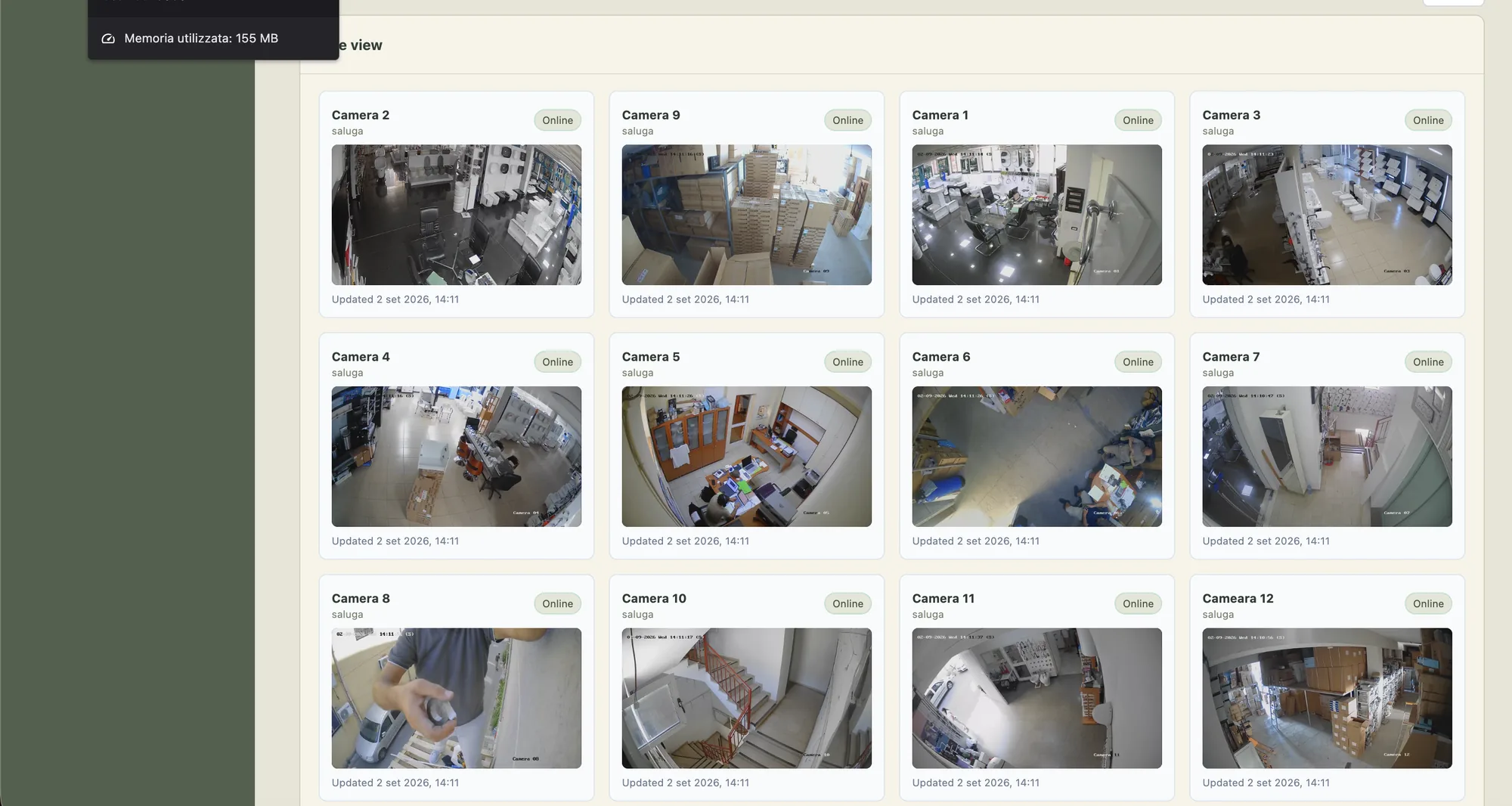
See the live field, not only the system status.

The live view keeps current frames, camera names, and availability together. Before a rule, model, or incident asks for attention, an operator can tell the difference between a quiet scene and a missing signal.

That makes coverage a living operational map. The condition has a specific world to watch, and the team can see whether that world is still present.

Argus live view showing current frames and online status across the site's cameras
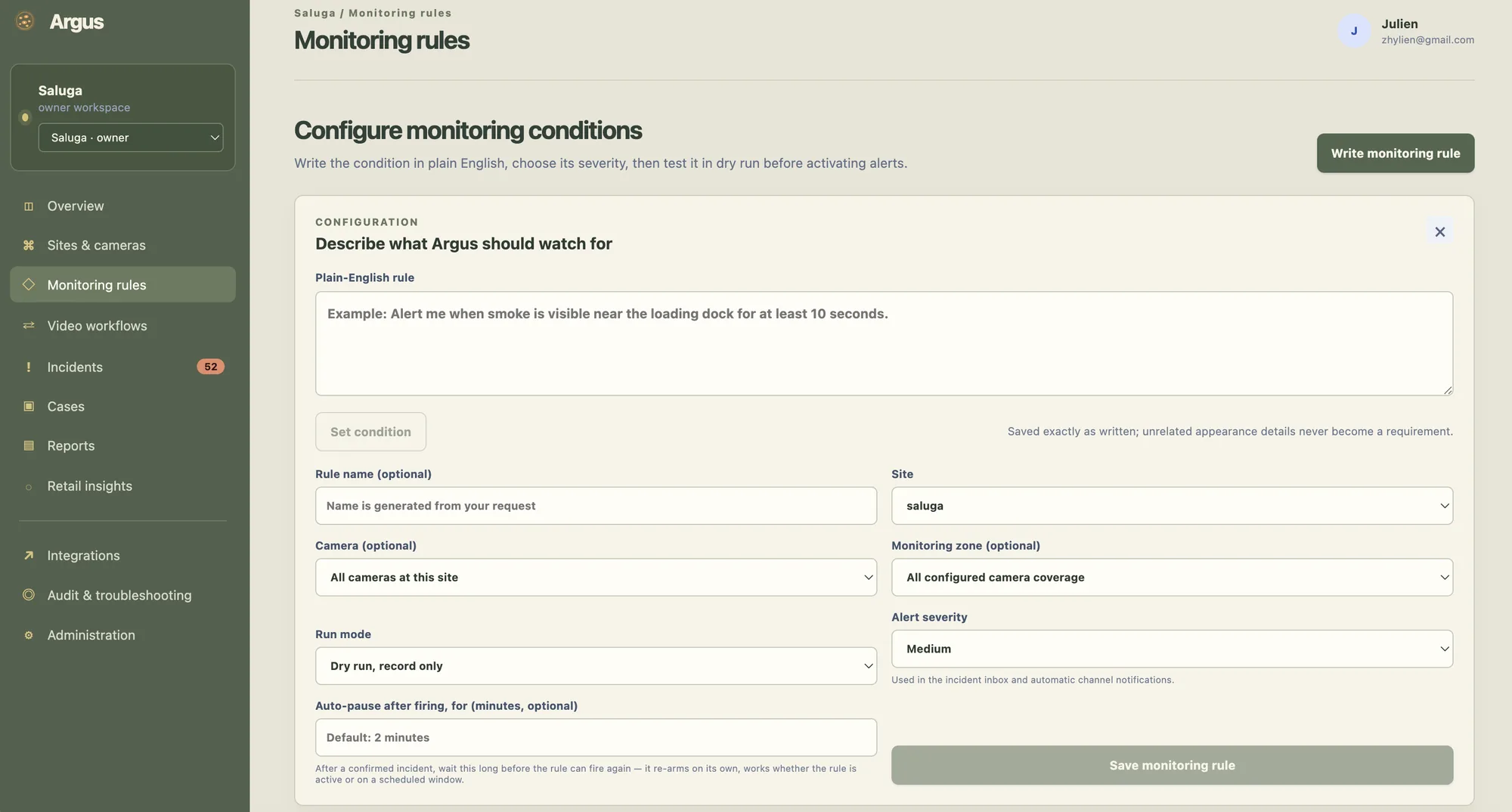
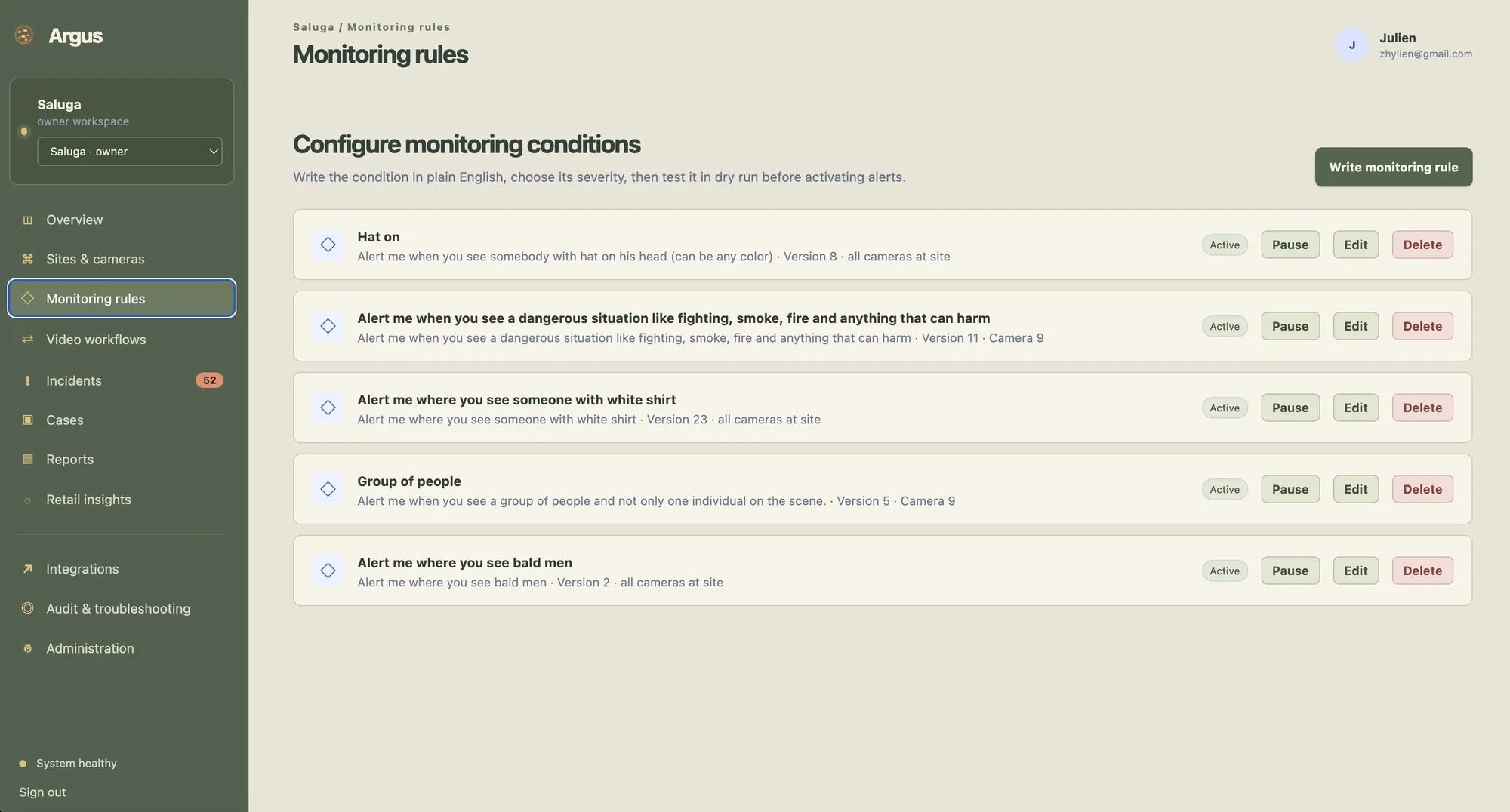
Argus monitoring rules list showing active rules, their plain-language condition, scope, and controls
Keep current rules visible. The rule list makes the condition, its scope, version, and active or paused state available before anyone has to interpret an incident.
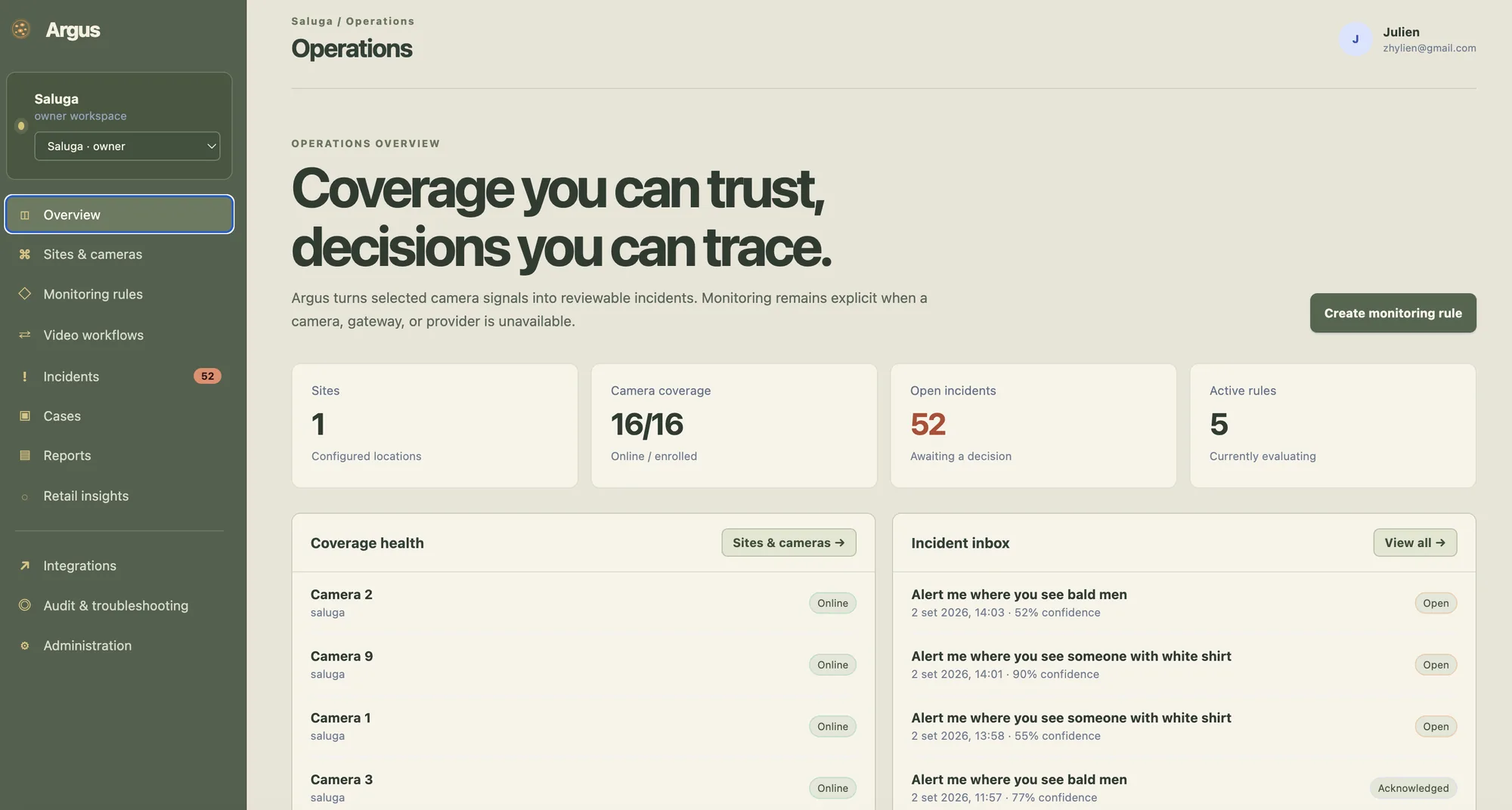
Argus operations overview showing camera coverage, active monitoring rules, and the incident inbox
Read the operating picture at a glance. Active rules sit beside coverage and the inbox, so the team can see what is evaluating and whether it has created work for someone to decide.
Watch a rule move through the system. The walkthrough follows the complete path from connected camera and written condition to reviewable incident, including scopes, dry runs, pausing, and the evidence that supports a decision.

Make attention reviewable before it becomes urgent.

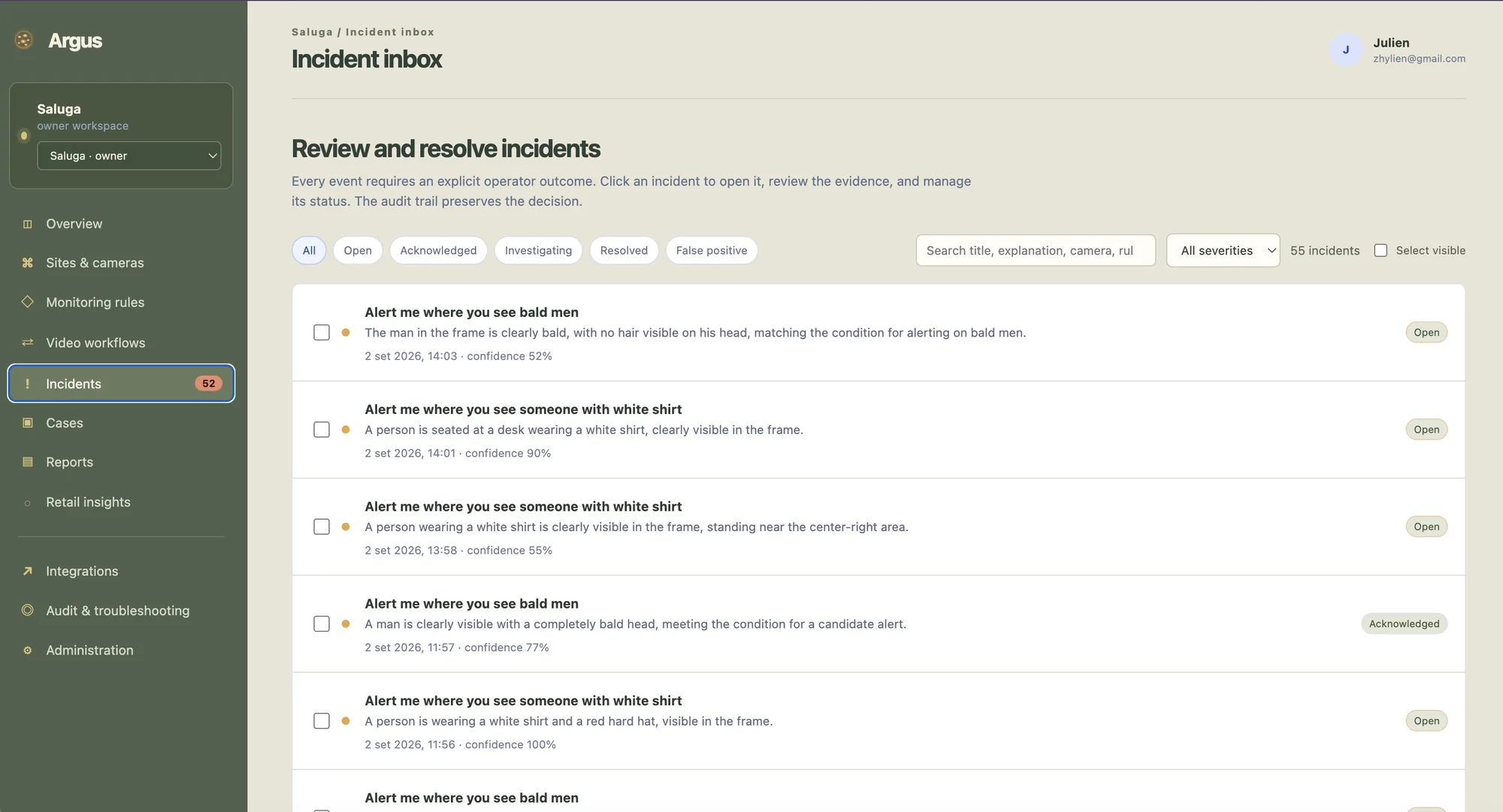
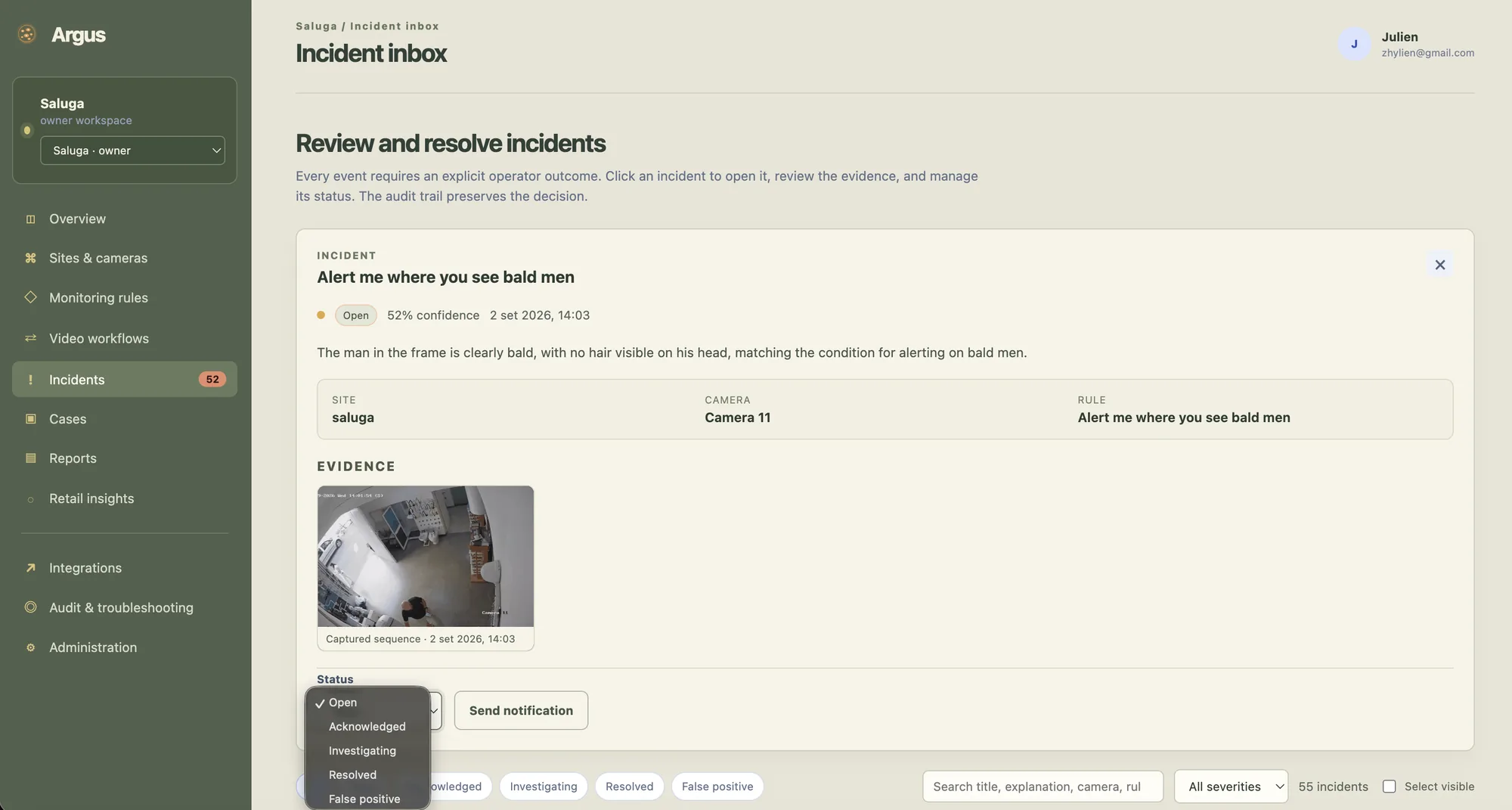
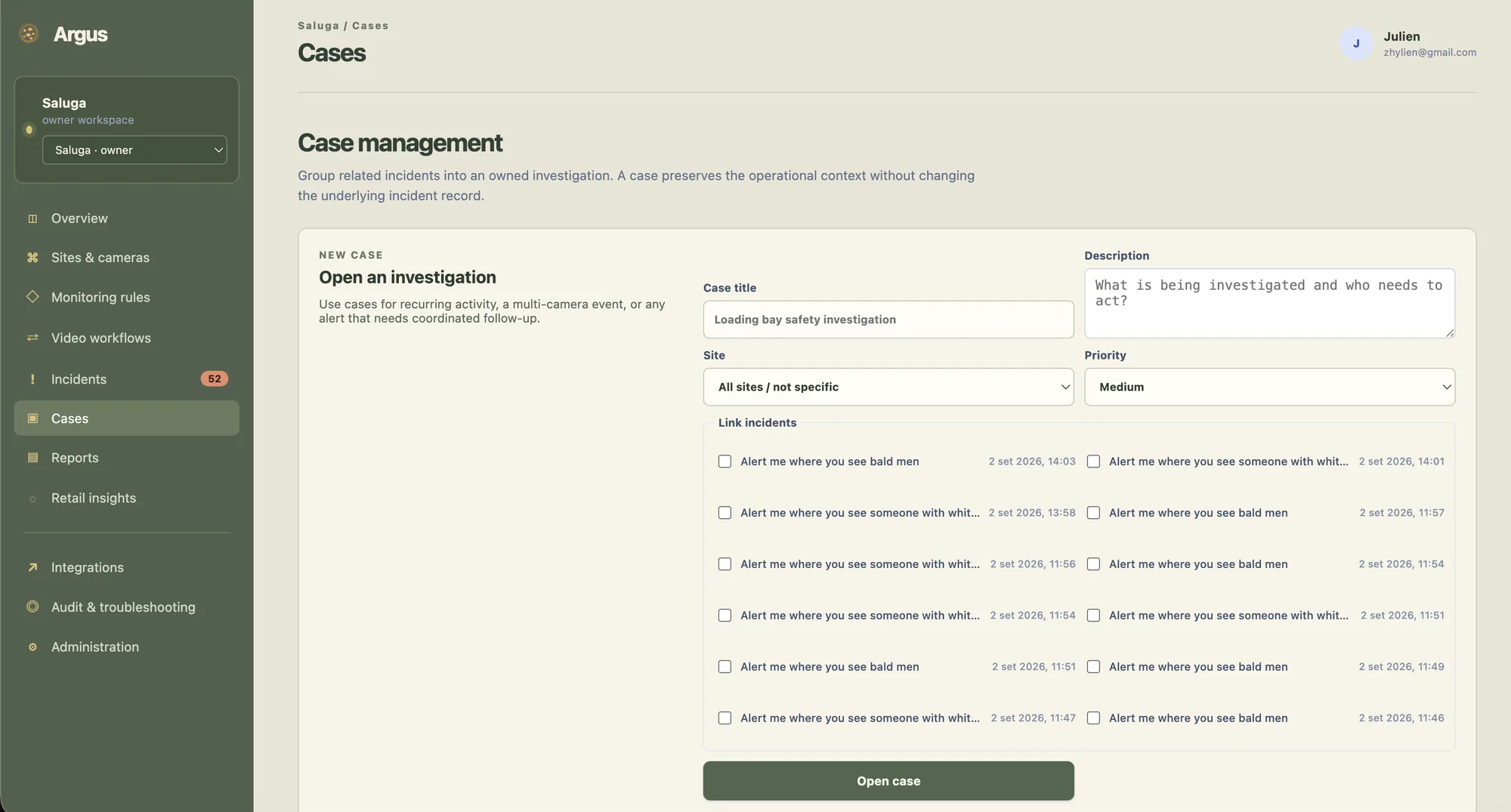
The inbox keeps new, acknowledged, investigated, resolved, and false-positive events in separate but connected states. An operator can filter the work, open the evidence, and make an explicit outcome instead of letting an alert disappear into a wall of notifications.

It does not pretend that every candidate is true. Its value is that the people responsible can see what still awaits a decision and can trace what was already decided.

Argus incident inbox grouping alerts by their explicit operator resolution state

A model with boundaries

A candidate must prove more than a confident answer.

Argus is selective before it is intelligent. An edge gate makes a quiet camera free to ignore; a second, block-aware check lets a local change earn a closer look. Only then does a vision model assess the site's written condition, and its candidate enters a deterministic corroboration path that can confirm, clear, or keep gathering evidence.

Gate twice

Start at the edge, then preserve a meaningful local change at the control plane before a model call.

Corroborate over time

Accumulate supporting and counter-evidence from distinct observations, with stale evidence losing weight.

Decide with a person

Surface the condition, evidence, and resolution together so someone accountable can decide what follows.
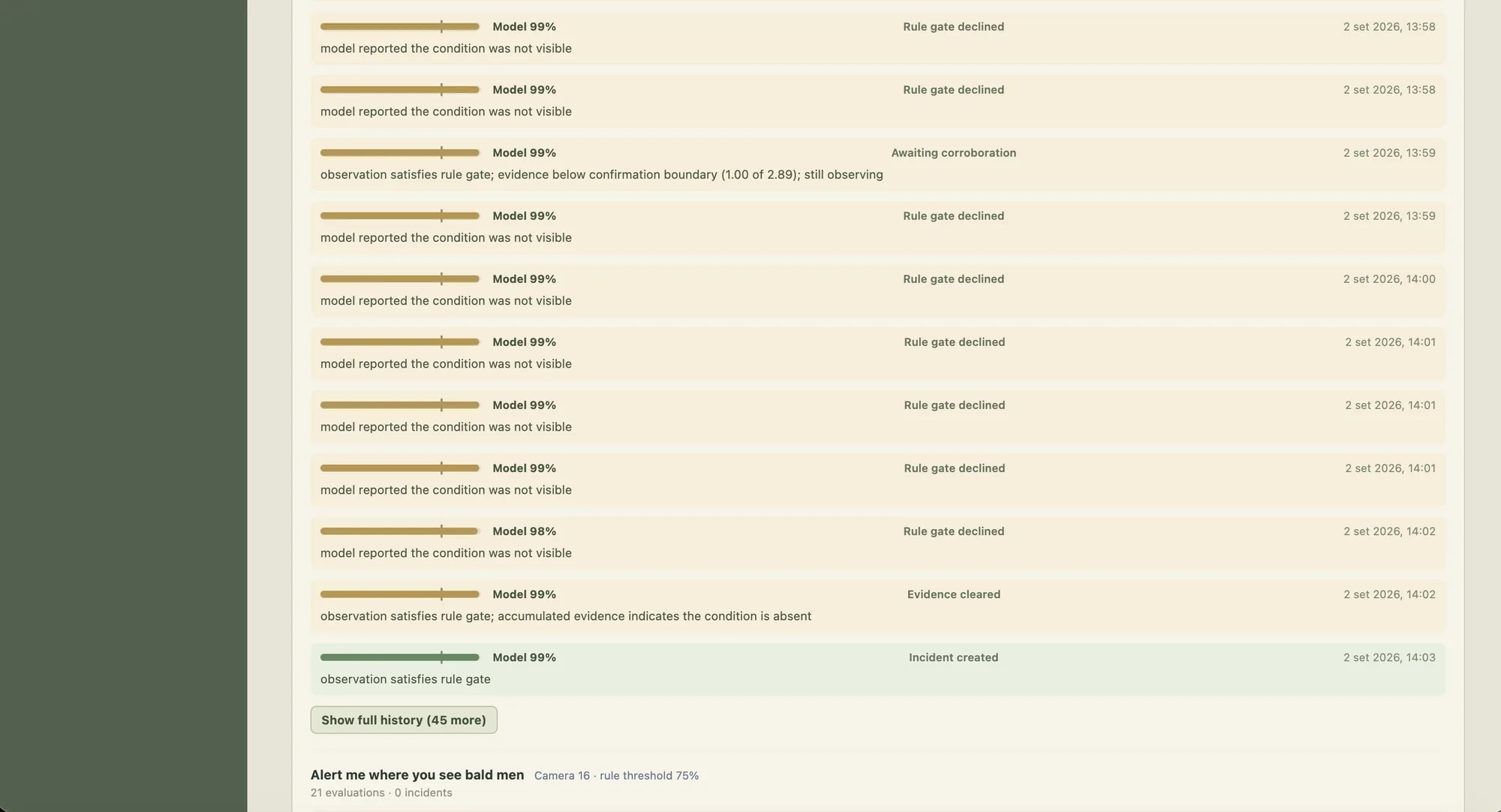
Argus analysis history showing model responses, rule-gate outcomes, corroboration, and incident creation

Show how a conclusion was earned.

The analysis history records the model response, deterministic rule gate, and each observation's place in the corroboration path. It shows whether the system is still gathering evidence, has cleared it, or has opened an incident. A confident negative counts too, so the record can show why an early candidate was not promoted.

This is the practical difference between a confidence score and a decision: the evidence that changed the state remains available to inspect.

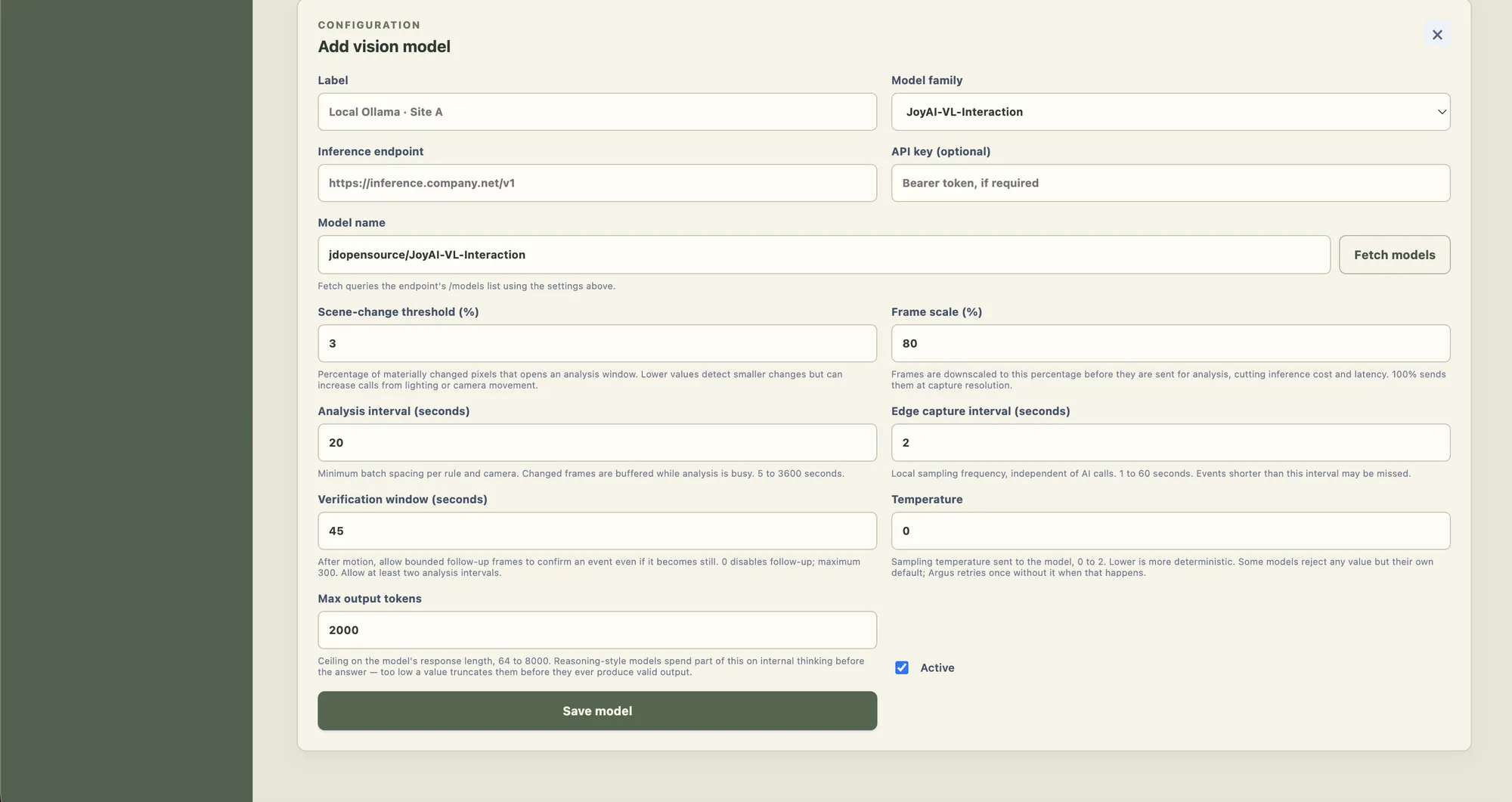
Argus vision model configuration showing provider, model, endpoint, and testable connection settings

Make the model part of the operating record.

Each organisation can configure, test, and identify its own model connections. A site can use a chosen approved endpoint or an organisation default, while endpoint and model details stay visible to the people who operate it.

The platform is not committed to one provider. It is committed to the same inspectable policy and corroboration path whichever approved model a site uses.

Operational ground

Keep the camera inside the site, and the operating record within reach.

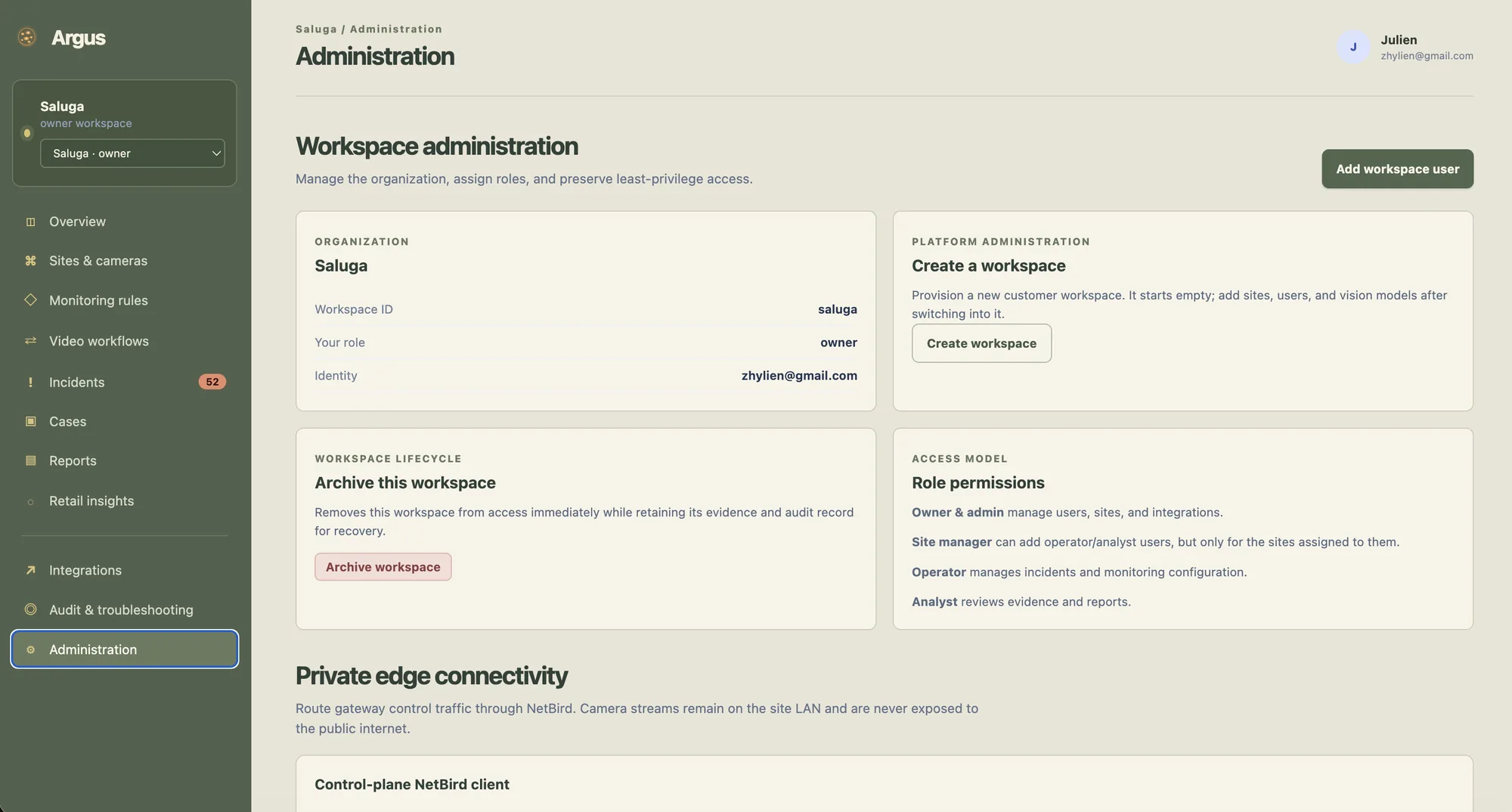
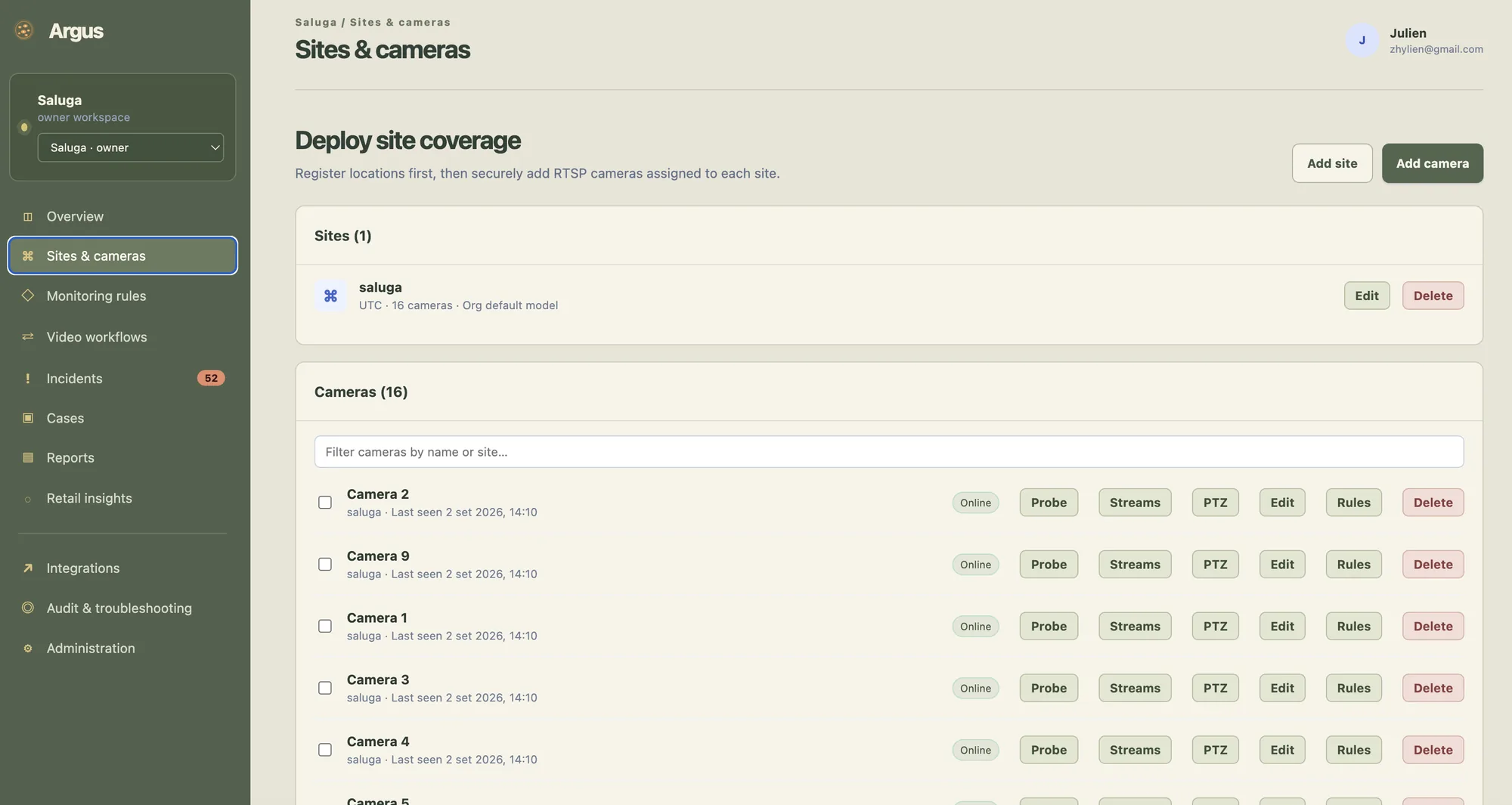
Argus connects the edge through a private overlay rather than exposing RTSP feeds or credentials to the public internet. The administration surface makes the service endpoint, workspace roles, and site connection legible to the people who run it.

That separation is practical. A quiet camera, a disconnected gateway, and a missing permission are different conditions. Argus records them as different conditions before an operator is asked to interpret video.

Argus workspace administration showing a private edge connection, access roles, and workspace controls
Infrastructure is part of coverage, not a hidden assumption.

More than alerts

The ordinary hours belong in the record too.

Argus uses the same discipline for reports and scene narratives. Each account is built from stored observations, incidents, and coverage data, so a shift can be understood without turning missing footage into a claim.

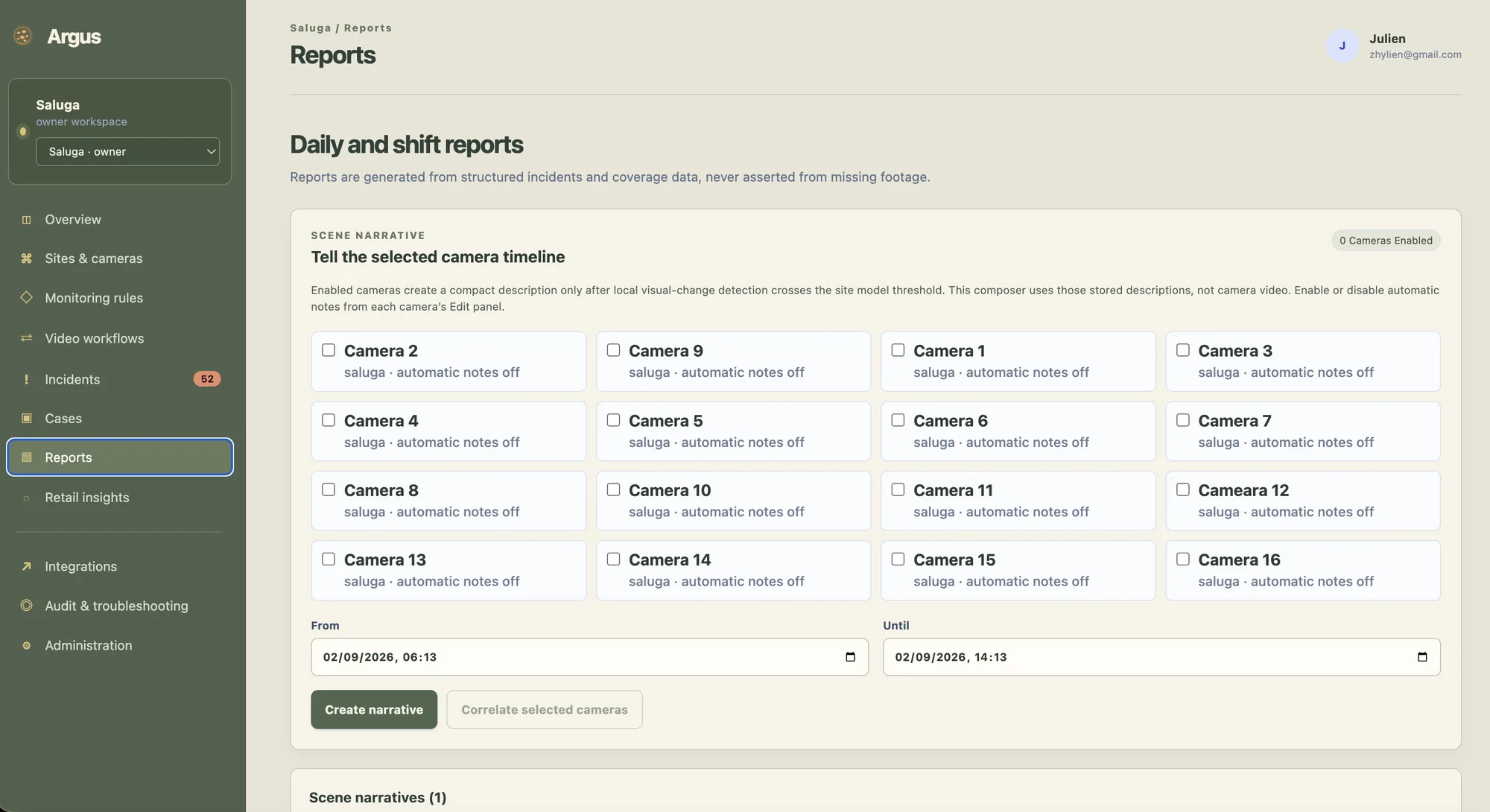
Argus reports screen for composing a time-bound scene narrative from selected cameras

Ask for a report from the evidence already collected.

The reports view deliberately selects cameras and a time window. It makes clear that a narrative uses the stored scene notes produced by those cameras, rather than claiming to see footage that was never gathered.

A daily or shift report becomes a reviewable operational artifact, not a generic AI summary.

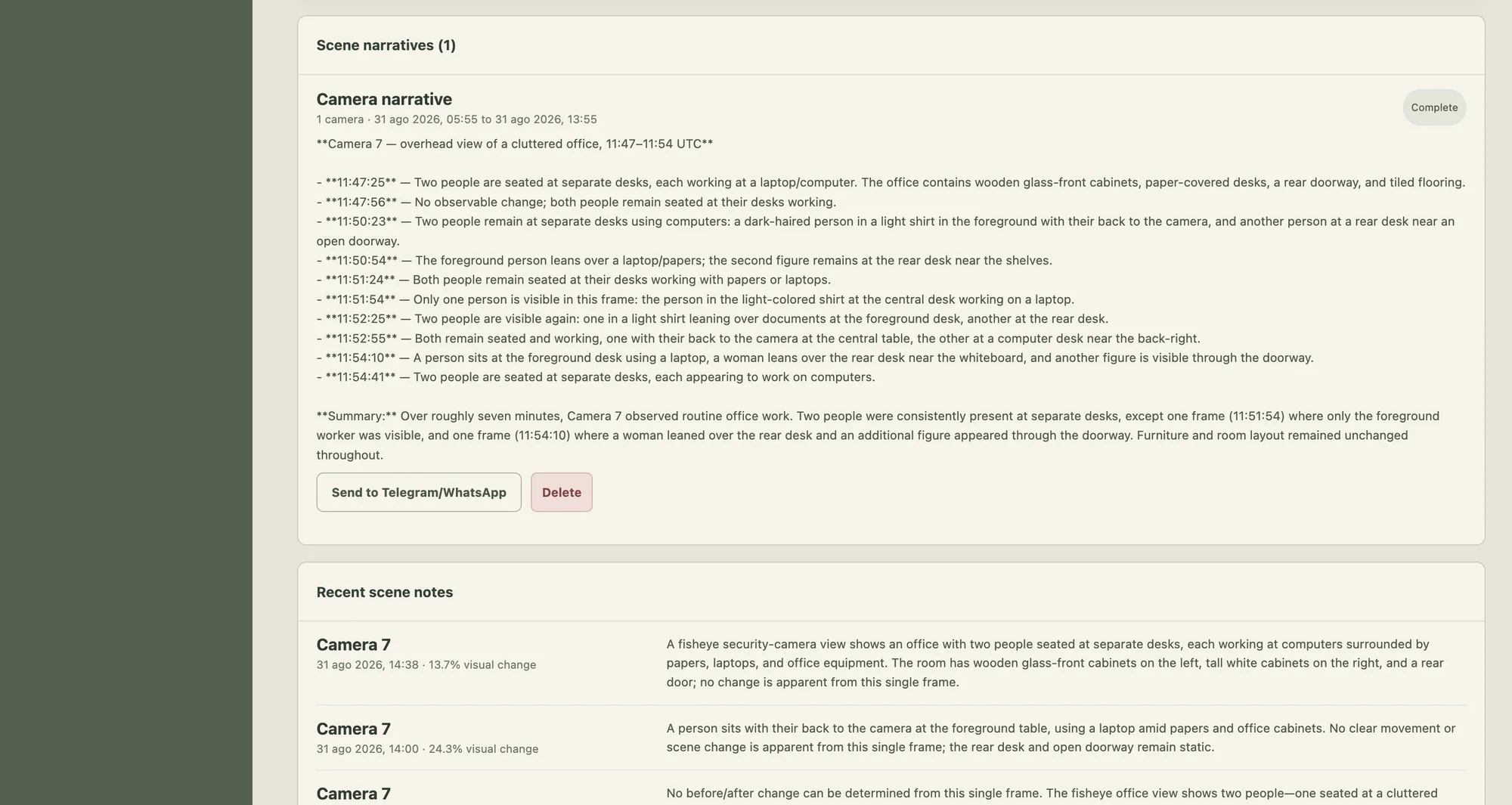
Argus scene narrative showing timestamped observations and a summary for one camera

Read the day as a sequence, not a pile of clips.

Here Argus presents a camera narrative with timestamped notes and a bounded summary of what stayed consistent and what changed. This is not an incident screen. It is the useful story between incidents, with enough detail for a person to decide whether the ordinary pattern deserves a closer look.

The account remains reversible: it can be sent on demand, scheduled for delivery, or deleted when it no longer belongs in the record.

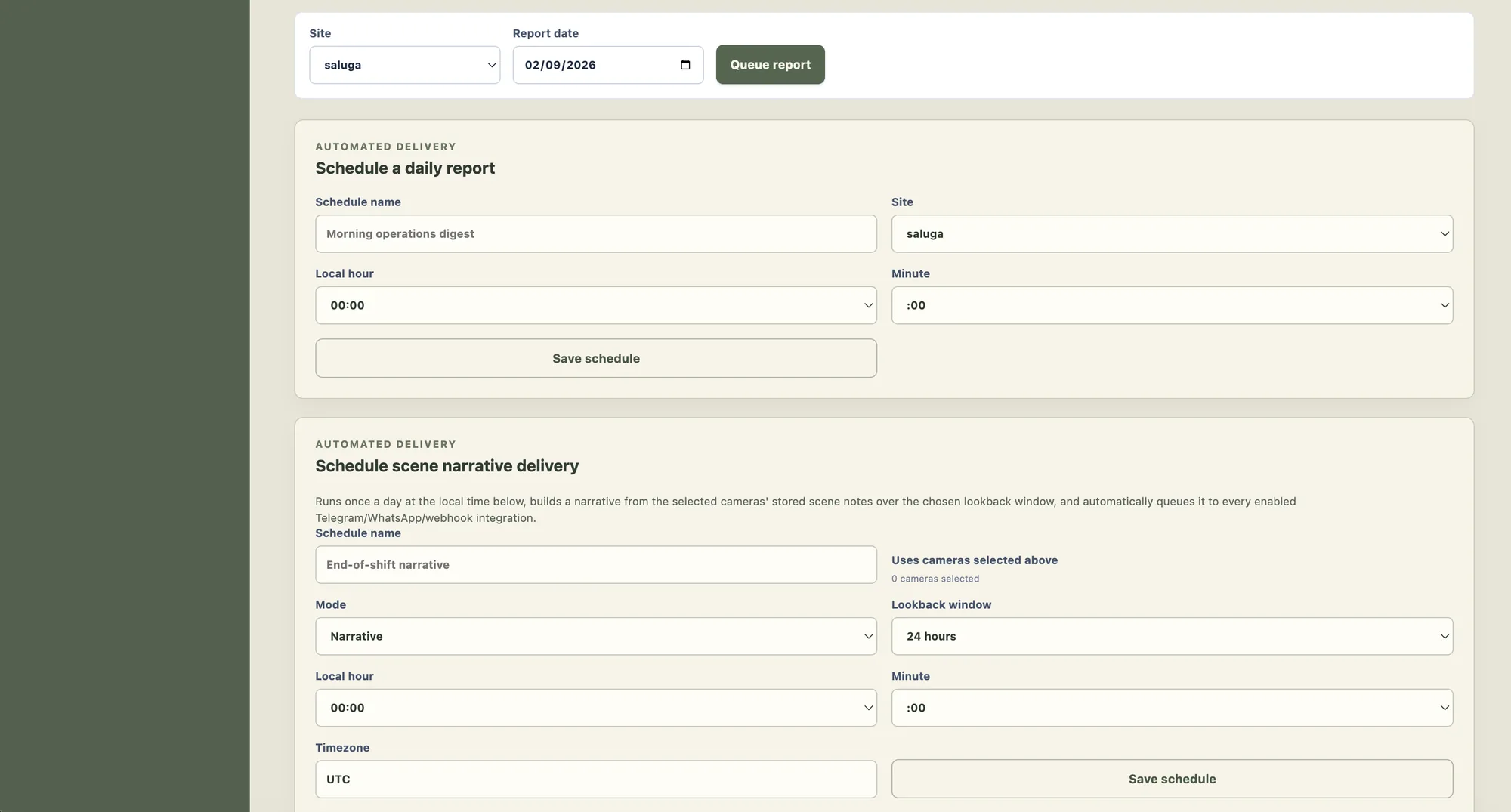
Argus reporting schedules for daily reports and scheduled scene narrative delivery

Let useful attention arrive on a rhythm.

Daily reports and scene narratives can be scheduled in the site's own local time. A rule can also observe only during its relevant arm window and rest during a cooldown, so Argus is designed for the second and hundredth occurrence, not only the first demonstration.

Work that keeps moving

Process, deliver, and retry without losing the trail.

Argus treats recordings and notifications as operational work, not as loose files and one-shot messages. The record remains observable from the source capture through the workflow and the delivery outcome.

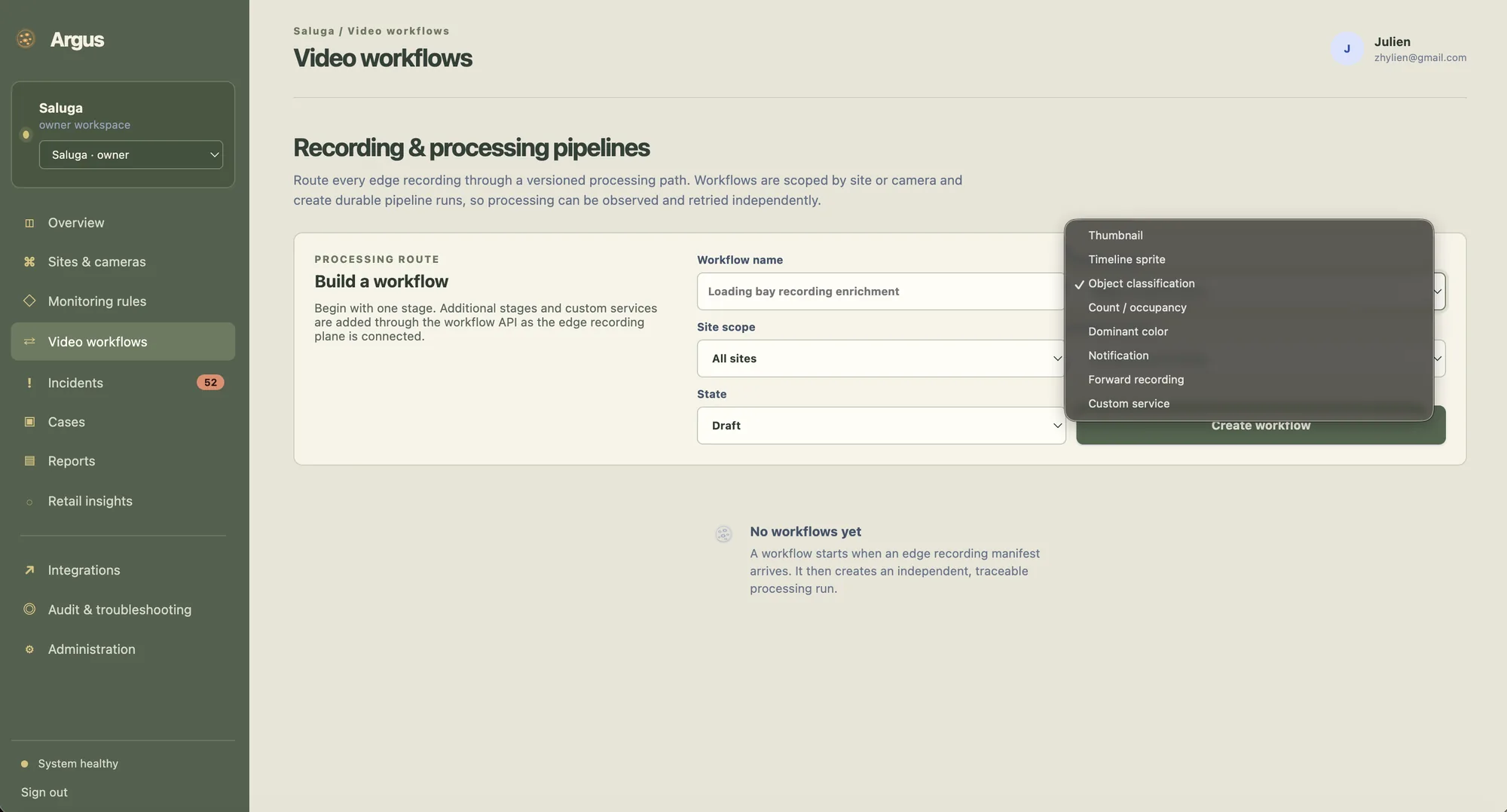
Argus video workflow builder showing selectable recording and processing stages

Workflow stages

ThumbnailTimeline spriteObject classificationCount / occupancyNotificationCustom service

Process

Give each recording a durable route.

A site or camera can route its recordings through a versioned workflow. Each run has its own progress and result, so it can be observed or retried without having to re-trigger the original recording.

Deliver

Send evidence where the team is.

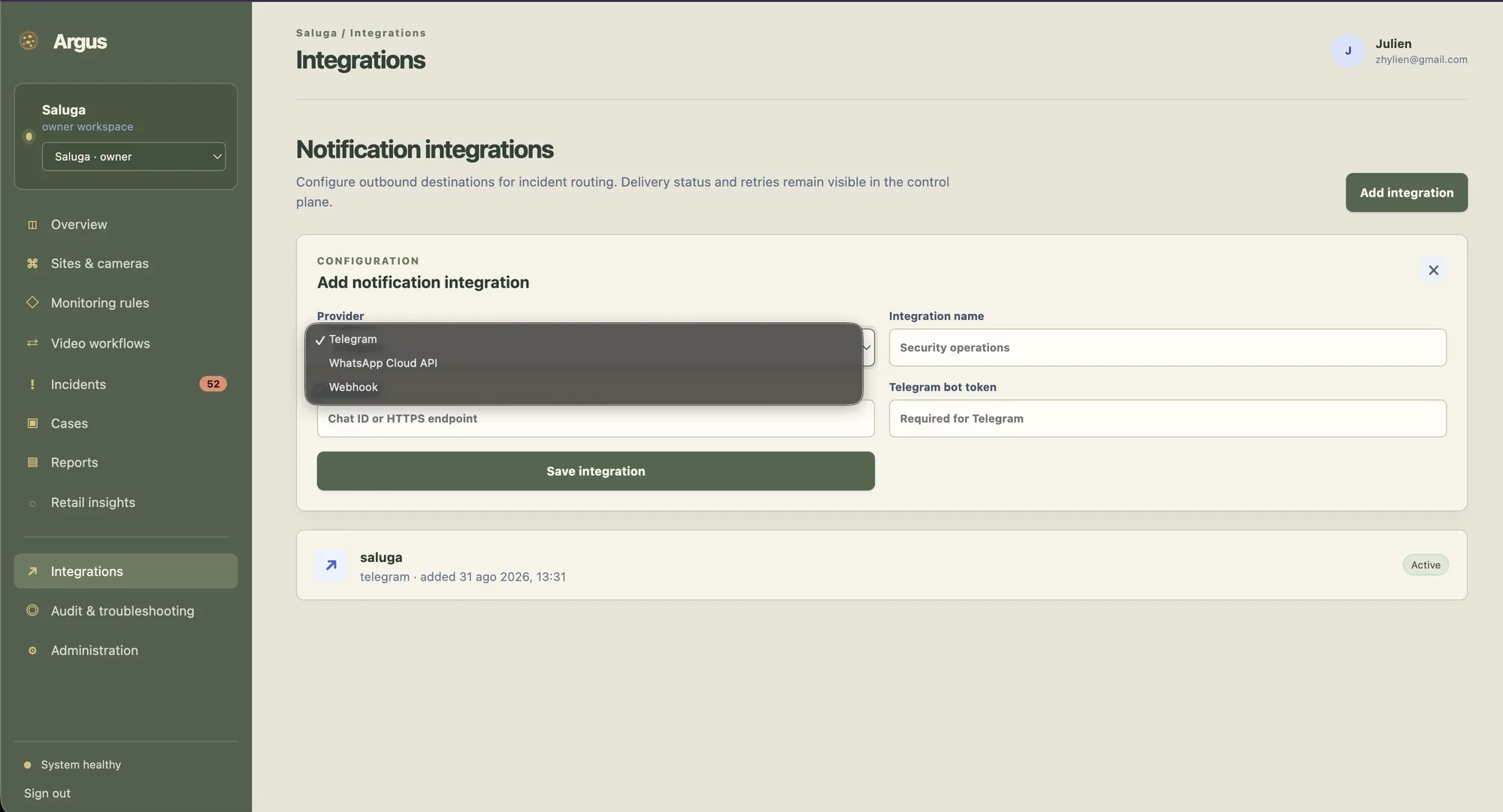
Argus can deliver evidence through Telegram, WhatsApp, or a customer webhook. The actual image or short GIF reaches the messaging service, while a webhook can receive the link it is able to access.

Recover

Keep a failed handoff visible.

Delivery retries respect provider backoff. A message that still cannot be delivered becomes a visible dead letter an operator can inspect and retry, instead of a failure hidden behind a green dashboard.

Argus notification integrations screen with Telegram, WhatsApp Cloud API, and webhook delivery options
The delivery channel is configured and visible, not assumed.

Aggregate retail insights

A separate instrument for understanding the floor.

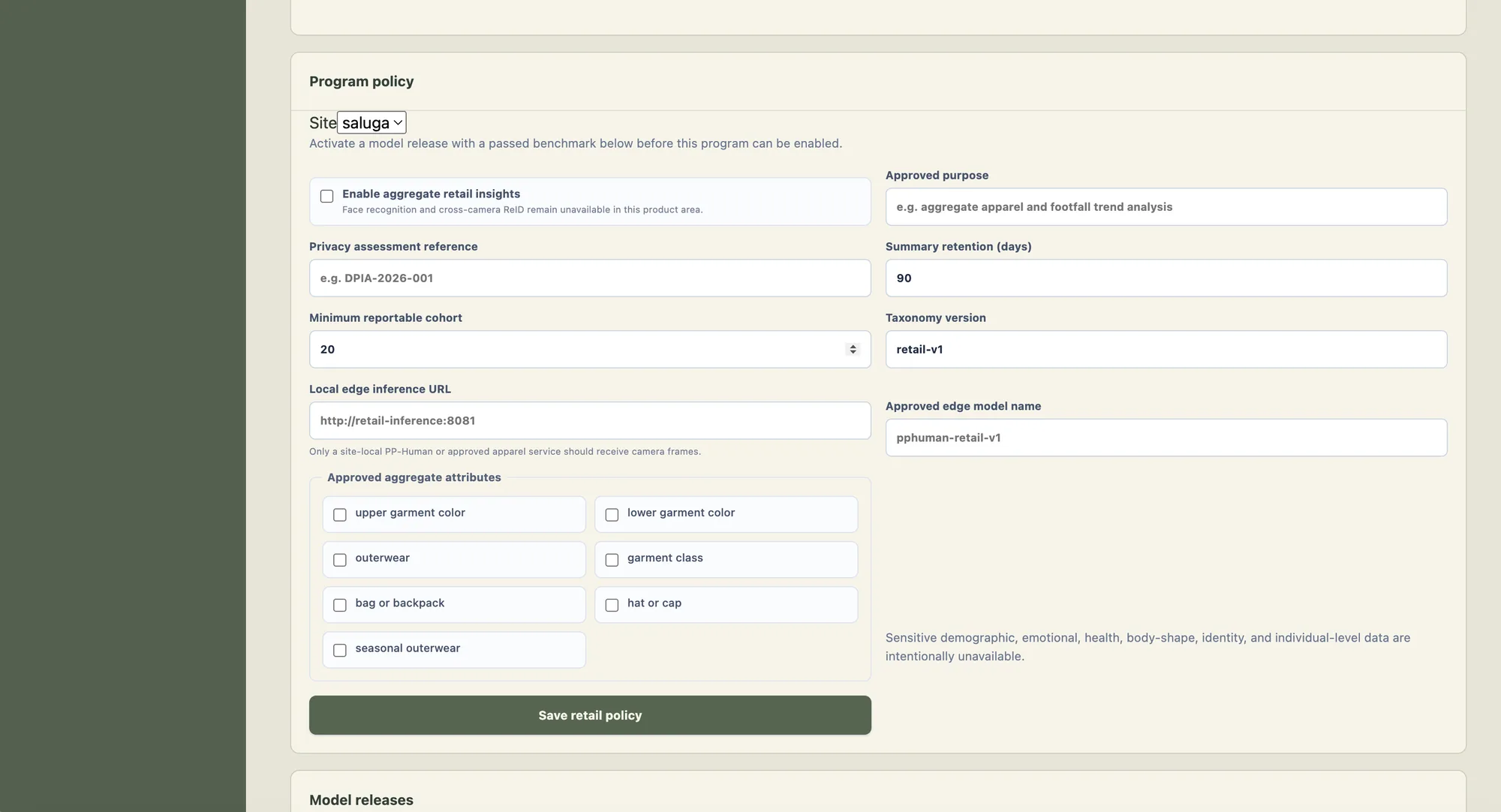
Retail Insights does not feed the incident pipeline. It has its own privacy boundary, policy, model-release gate, reporting surface, retention, and audit trail. It is designed for aggregate movement and apparel trends, not recognition, re-identification, or individual tracking.

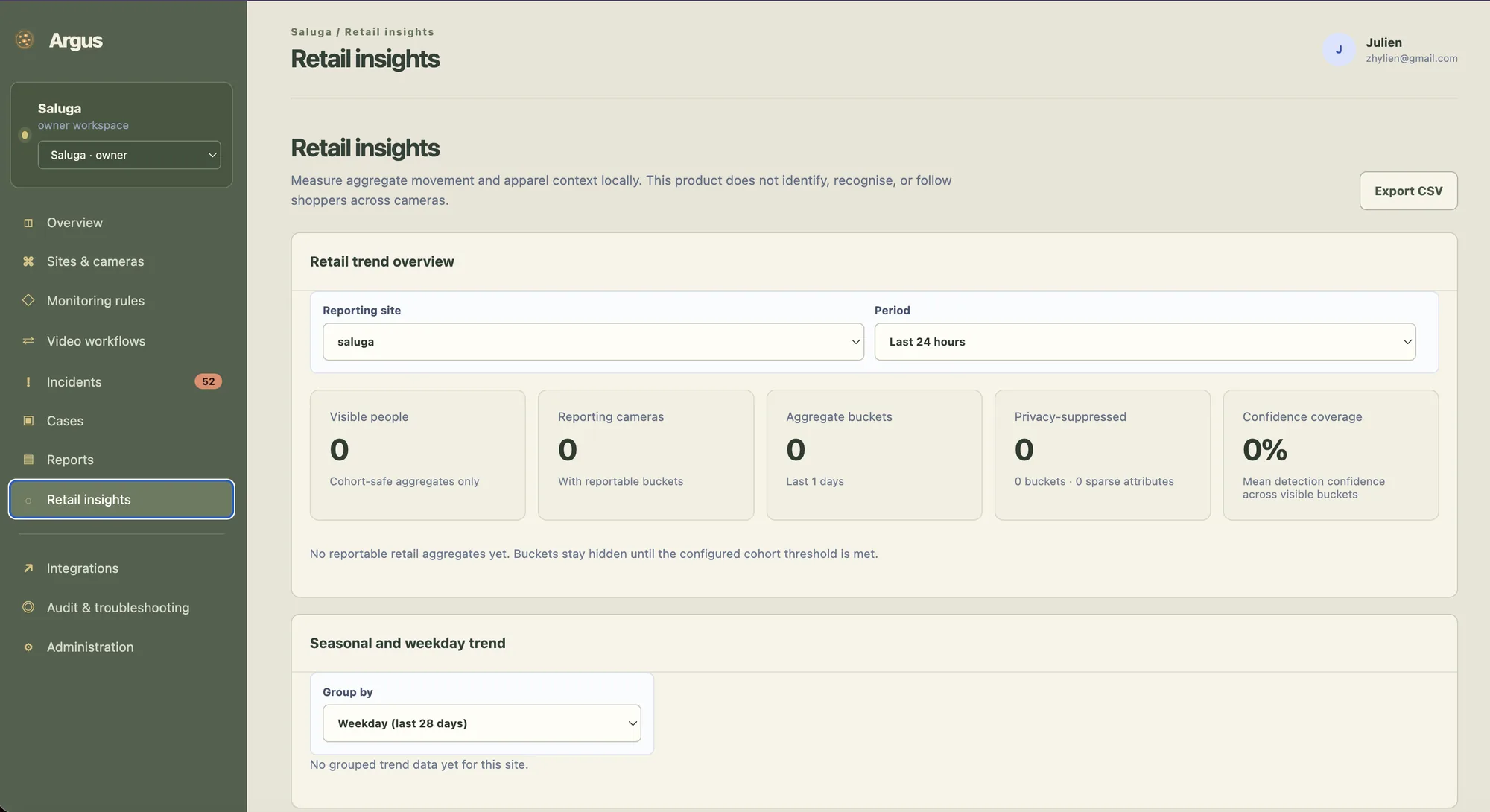
Argus Retail Insights overview showing aggregate buckets, privacy suppression, and confidence coverage

Read patterns at the scale where a store can respond.

The reporting view is designed to answer operational questions without making a visitor the unit of analysis: when a site becomes busier, how movement shifts by zone and direction, which weekday or campaign pattern has changed, and whether the reading is supported by enough healthy coverage to use.

Argus retail demo

A complete reading, not a single headline.

22 Sep – 18 Oct 2026 · 27 days of aggregate buckets from the Argus demo workspace · looped demo footage, no individual is tracked

168,737
aggregate detections, 5,071 fifteen-minute buckets
+20%
latest complete week, 61,909 vs 51,654 (+25% the week before)
11,988
busiest day, Sun 11 Oct, with Saturday 10 Oct close behind
13:00
busiest hour, UTC, 16,099 detections across the period
237,647
frames analysed locally, 0.8% dropped
43%
of buckets withheld because the cohort was too small

Traffic by day, with its own trend

Camera detections, not unique shoppers. UTC days.

Day 7-day average Incomplete capture
4k8k12k22 Sep28 Sep5 Oct12 Oct
Daily detections
DateDetections
22 Sep648
23 Sep1,107
24 Sep278
25 Sep4,733
26 Sep9,740
27 Sep7,662
28 Sep5,119
29 Sep2,665
30 Sep4,296
1 Oct7,086
2 Oct7,879
3 Oct6,215
4 Oct6,616
5 Oct8,683
6 Oct8,929
7 Oct6,759
8 Oct6,573
9 Oct8,263
10 Oct11,140
11 Oct11,988
12 Oct10,050
13 Oct4,657
14 Oct8,170
15 Oct7,641
16 Oct8,102
17 Oct3,649
18 Oct89

The seven-day average rises from 5,900 to 8,821 a day between 1 and 16 October. The first three and last two days are capture ramp-up and wind-down; they are shown, but kept out of every comparison.

Every day at a glance

Calendar heatmap, one cell per day

0.6k1.1k0.3k4.7k9.7k7.7k5.1k2.7k4.3k7.1k7.9k6.2k6.6k8.7k8.9k6.8k6.6k8.3k11.1k12.0k10.1k4.7k8.2k7.6k8.1k3.6k0.1kMoTuWeThFrSaSu21 Sep28 Sep5 Oct12 Oct

Weekends carry the strongest cells; the second weekend of October is the high point of the report.

Week over week

Complete Fri–Thu weeks

3 complete weeks
  1. 25 Sep – 1 Oct41,301
  2. 2 – 8 Oct51,654+25%
  3. 9 – 15 Oct61,909+20%
Week over week
WeekDetections
25 Sep – 1 Oct41,301
2 – 8 Oct51,654
9 – 15 Oct61,909

Each week is compared with the one before, on the same weekdays, never with a partial one.

The shape of the day

Detections by UTC hour, whole period

13:00
000306091215182116,099
Detections by UTC hour, whole period
Hour (UTC)Detections
00:003,320
01:003,859
02:003,266
03:004,895
04:004,817
05:005,224
06:005,475
07:005,292
08:0010,478
09:0011,974
10:0013,092
11:0010,738
12:0013,835
13:0016,099
14:0013,011
15:008,855
16:006,850
17:005,424
18:004,491
19:004,961
20:005,218
21:002,499
22:002,412
23:002,652
00–07
21% 36,148
08–15
58% 98,082
16–23
20% 34,507

The shape of the week

Average detections per weekday, 22 complete days

8.0kMon
5.4kTue
6.4kWed
7.1kThu
7.2kFri
9.0kSat
8.8kSun
Average detections per weekday
WeekdayDetections
Mon7,951
Tue5,417
Wed6,408
Thu7,100
Fri7,244
Sat9,032
Sun8,755

Saturday and Sunday lead; Tuesday is the quietest weekday.

Upper garment colour

Share of 168,700 attributed detections

  1. black51.7%
  2. gray17.7%
  3. blue13.0%
  4. other8.2%
  5. white4.1%
  6. brown3.3%
  7. red1.1%
  8. other hues1.0%

Garment class

Sleeve and leg length, combined

  1. Short sleeve, long trousers42.1%
  2. Short sleeve, shorts / skirt32.0%
  3. Long sleeve, long trousers12.6%
  4. Other11.9%
  5. Long sleeve, shorts / skirt1.3%

Carried and worn

Share of detections where the cue was present

  1. Bag or backpack42.8%
  2. Backpack24.2%
  3. Long hair15.7%
  4. Long sleeves22.8%
  5. Hat or cap7.6%
  6. Coat or jacket5.0%

What the report is allowed to say

5,071 buckets by privacy outcome

Reported
1,698 carry 99.8% of detections
Pooled
1,207 small cohorts merged, 340 detections
Withheld
2,166 suppressed before storage, no count kept

Default minimum cohort: 20 people before an aggregate is reported; smaller groups stay withheld. Apparel cues only, no faces and no identities.

Confidence beside the trend

Mean detection confidence by week

0.3621 Sep
0.3928 Sep
0.445 Oct
0.4012 Oct

Coverage comes from one street camera (99.8% of detections) plus two near-silent ones. The report says so, so a change in coverage is never read as a change in demand.

Where the floor is used

Occupancy heatmap, 32 × 18 grid over the camera view

1,437,755 samples
Busiest cells of the occupancy heatmap
RankColumnRowSamples
1231024,401
2271122,306
3231121,647
4111121,523
5241021,382
6261120,805
7241120,427
8251020,279
9251119,781
1025918,475

Occupancy gathers in the lower half of the view: 218 cells ever used, and the busiest 10% of them hold 28% of all samples. Only cell counts leave the camera, never a track.

Which way it flows

Net direction between neighbouring cells, 16 × 9 grid

Strongest net flows between cells
RankFrom columnFrom rowTo columnTo rowNet count
11151241,248
21351361,211
3125124965
4116125924
5106115875
6115125813
7124134800
8106125766
9125134754
1096115688

Each arrow is the net flow between two cells after the opposite direction is subtracted, so back-and-forth jitter cancels and only a lasting current remains. Thickness follows volume.

The floor changes through the day

Same grid, split by UTC time of day, each scaled to its own peak

00–07 UTC22% of samples

08–15 UTC65% of samples

16–23 UTC12% of samples

Most travelled paths

Zone-to-zone walks on an 8 × 5 grid

  1. 1,2431.0% of 123,823 walks
  2. 1,0270.8% of 123,823 walks
  3. 8610.7% of 123,823 walks
  4. 8280.7% of 123,823 walks
  5. 8070.7% of 123,823 walks
  6. 7210.6% of 123,823 walks

Read forward, with a range

Next seven days, from the same weekday in the last three complete weeks

Min–max Mean Latest week
4k8k12kSatSunMonTueWedThuFri
Same-weekday range, next seven days
WeekdayMinMeanMax
Sat6,2159,03211,140
Sun6,6168,75511,988
Mon5,1197,95110,050
Tue2,6655,4178,929
Wed4,2966,4088,170
Thu6,5737,1007,641
Fri4,7336,9588,263

A plain same-weekday band for this page. In the product, the forecast shows only after complete comparable days, with its back-tested error and the “same as last week” guess it has to beat.

Figures are real aggregates read from the Argus demo workspace, produced by its edge appliance on looped demo footage. They show how the instrument reads a place, not a customer result or a profile of any visitor. The Mneme exchange is an example composed from these same figures.

Plan the floor around a demonstrated rhythm.

Daily traffic, local hours, directional flow, and the camera contribution behind them make staffing, replenishment, and service placement discussable as a question about a place and a period.

Compare a campaign with the evidence it changed.

Period, zone, display attention, and apparel context can be held against a selected baseline. Supported movement and an early signal have different states, and both remain visible.

Let the report say what it cannot know yet.

Capture gaps, withheld cohorts, changed models, and weak agreement are part of the same reading. That makes the next check specific without pretending that an aggregate trend proves cause or conversion.

Aggregate only

Count a flow, not a person.

A temporary, per-camera track prevents duplicate counting only while someone crosses a zone. Once an aggregate bucket is written, its track, crop, and reusable embedding are discarded.

Suppress by design

Keep small groups out of view.

A cohort below the configured minimum is suppressed before storage. Sparse attribute combinations are redacted too, so a trend never becomes a back door to an individual.

Earn the report

Do not publish before the model is ready.

A site cannot enable reporting until its model release passes fixed benchmark checks. Data-quality signals stay beside every trend, so a quiet floor and an unreliable camera are never presented as the same thing.

Argus Retail Insights policy showing the separate approval, retention, taxonomy, and aggregate-only controls
Retail has a distinct policy surface because it has a distinct purpose.

The value is a clearer picture of a place, without making any visitor the subject of that picture.

Built for the work around the decision.

Argus keeps site access private through an overlay network, so cameras do not need to be exposed to the public internet. Edge health, queue pressure, retention, and audit history remain part of the same operational surface as the incident itself.

Organizations, sites, memberships, and roles shape every action. The system can coordinate a large estate without making the local owner, the camera, or the original condition disappear from the record.

That is the real value of attention here: less time scanning what is ordinary, more time understanding the moment that changes what someone should do next.

Argus gives people more time to notice, and more evidence to decide.

Return to works