softmachines
All works

A Softmachines work · Primary care

Care that extends attention without taking judgment away.

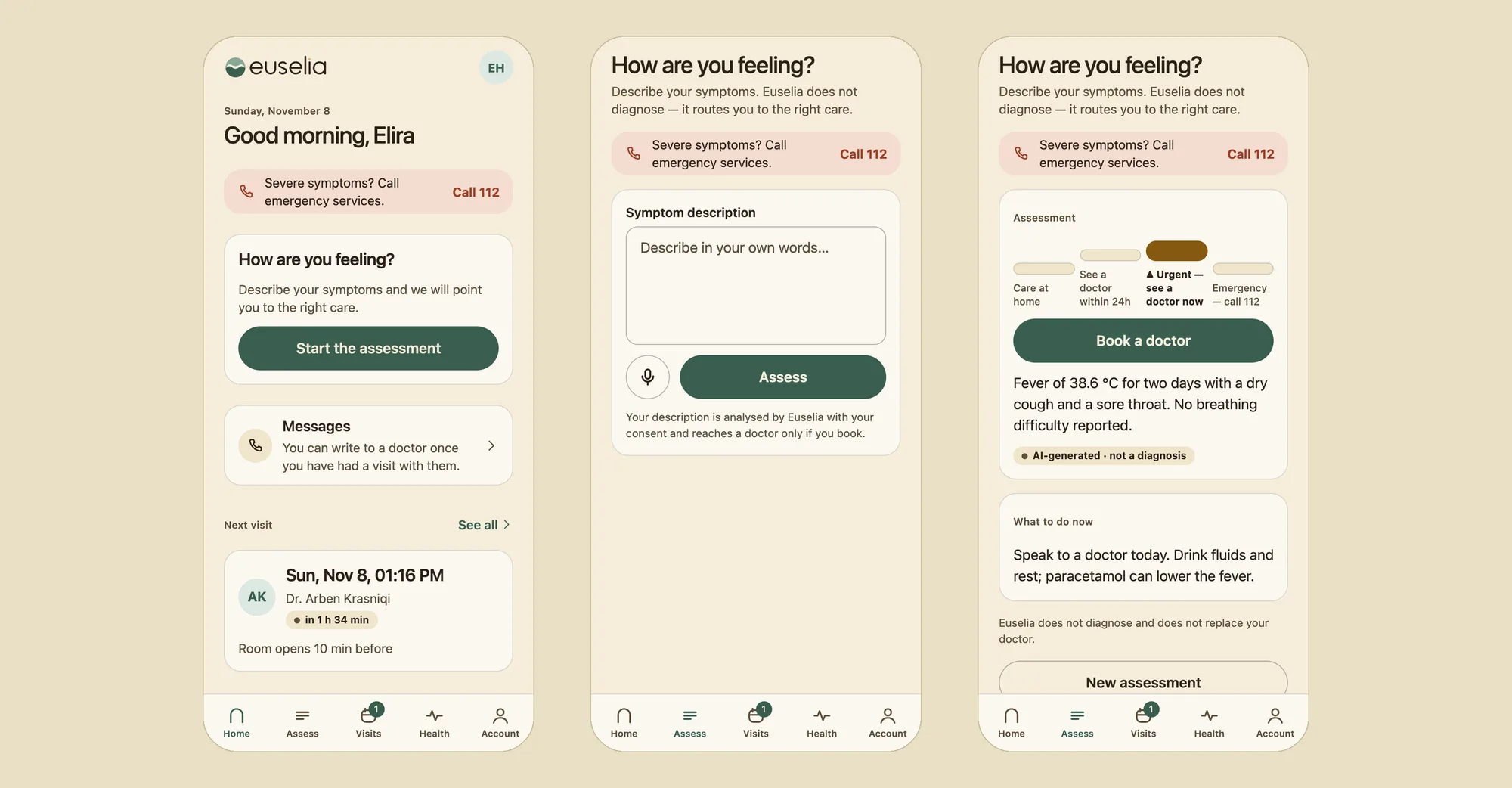
Euselia is a primary-care platform for the Albanian-speaking world, from Tirana and Pristina to Tetova and the diaspora. A patient says how they feel and is routed to the right care. A doctor opens a day already arranged around who needs them first. Between visits, the platform listens to the patient's own devices on the doctor's behalf.

EuseliaTriage · Telemedicine · Chronic care · Wearable signals · Clinical record

Follow one day of care through Euselia
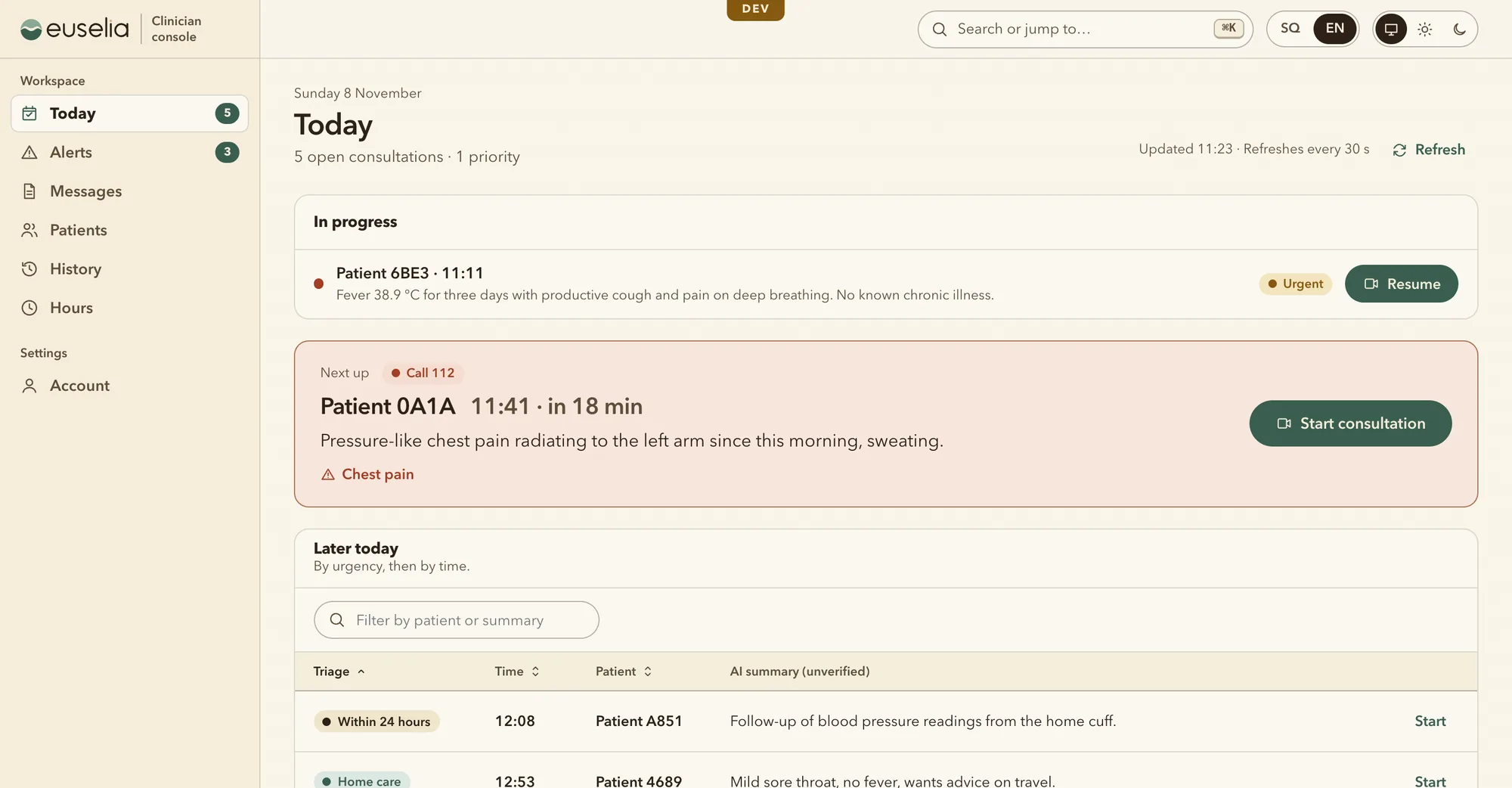
Euselia clinician console showing Today: the next consultation that needs the doctor, and the rest of the day ordered by urgency

Euselia is in development. It runs end to end on synthetic data; clinical validation, regulatory classification and real-device trials are the next stage. Every screenshot shows demonstration data.

The throughline

Notice early. Prepare well. Let the doctor decide.

Primary care is mostly attention: noticing that a cough has lasted too long, that a number has crept up, that a patient who always answers has stopped answering. Doctors are good at this and have less time for it every year. Where Euselia is built to work, the shortage is sharper: long distances, few clinicians, families spread across borders, and a language most health software has never been written in.

Software usually answers with one more screen, or with a confident machine placed between patient and doctor. Euselia takes a third position. The machine does the repeatable work of attention: it sorts by urgency, gathers what the record already holds and notices what has drifted from a person's own normal. It hands this to a human in a form that can be checked in seconds. The decision, the diagnosis and the responsibility stay with the doctor.

The result is one continuous line. What the patient says becomes the first thing the doctor reads. What the doctor concludes becomes the record the next doctor trusts. What a watch measures at night becomes a note on the morning's list.

One day of care

Every step hands the next one what it needs.

A day arranged around who needs the doctor next.

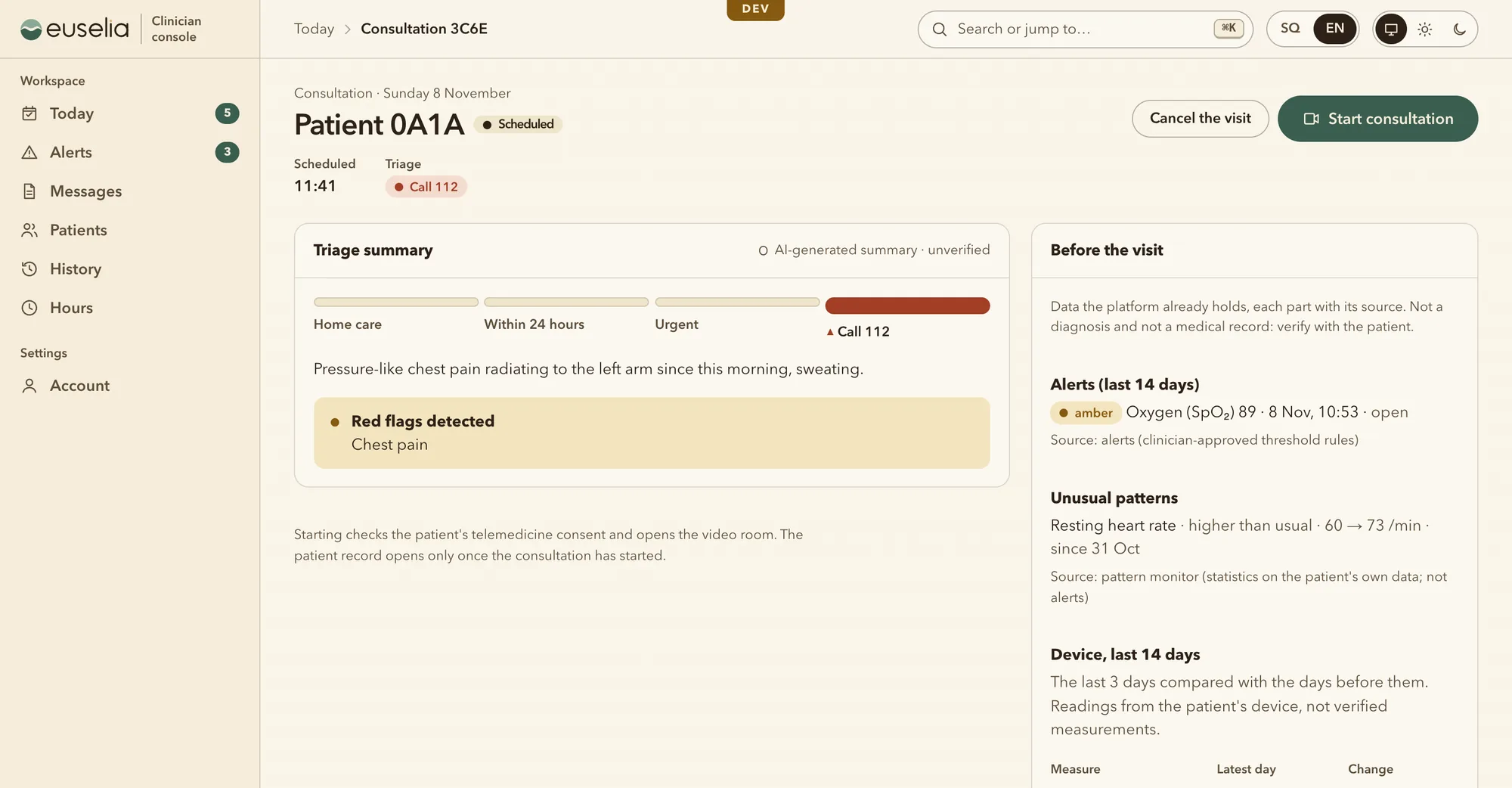
The doctor's first screen is not an inbox. It is Today: one card for the case that needs them next, the urgent ones above the rest, each row with a short patient-written summary marked unverified. Starting a consultation opens the video room beside a pre-visit brief, with every fact labelled by where it came from.

No language model writes the brief. It is arrangement, not generation, so there is nothing to invent. Prescriptions, certificates, referrals and sick-leave notes are issued from the same room, signed by a named doctor, and can be voided but never silently edited.

Euselia clinician console showing a consultation with a triage summary, a red-flag notice, and a pre-visit brief

Where the signals come from

The devices people already wear.

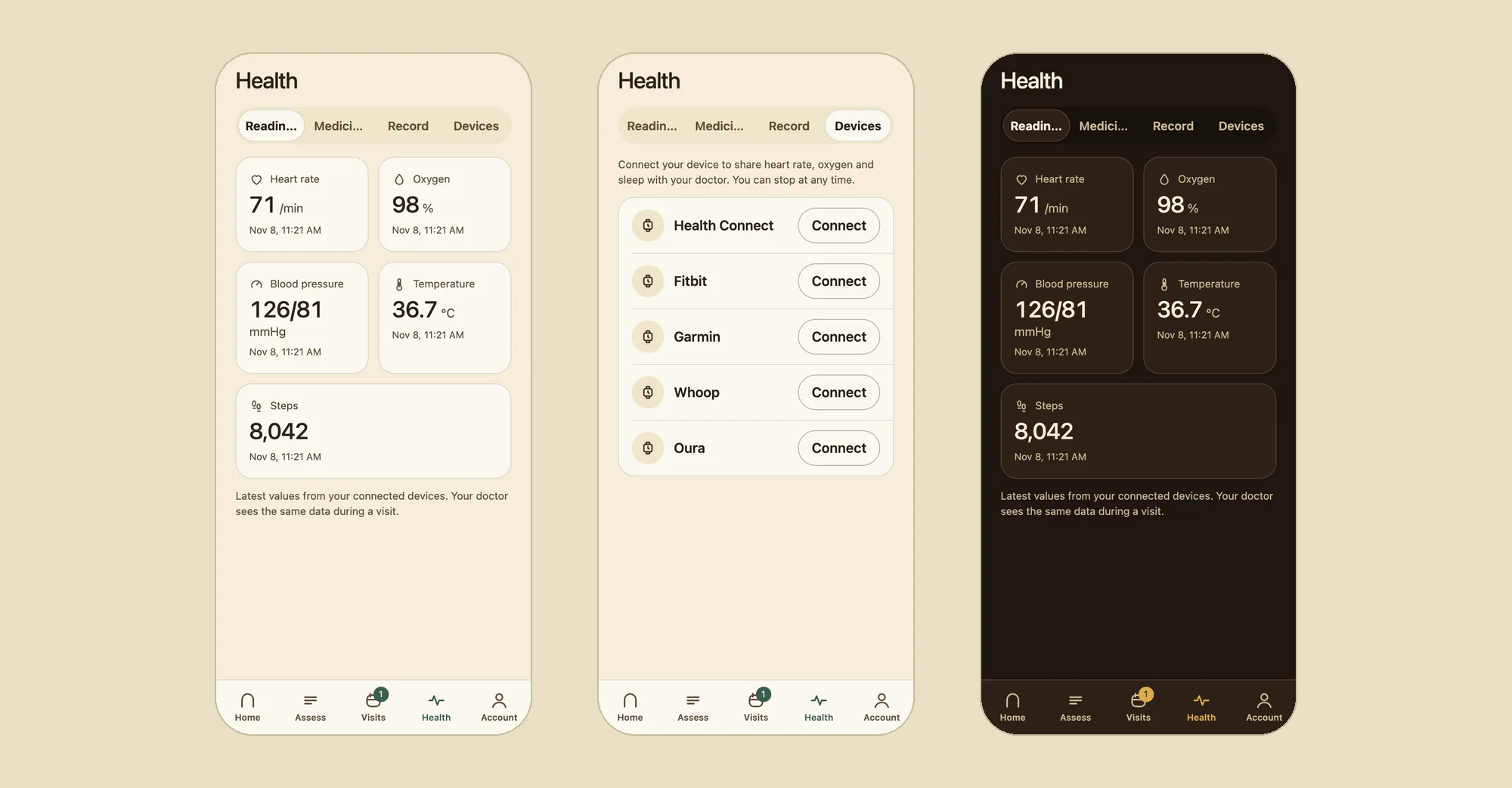
Euselia is built to connect the watches and health apps people already use, with the patient's explicit consent, through the open-source Open Wearables platform and open standards. The pipeline is tested end to end with simulated devices; trials on real devices are the next stage.

Euselia patient app showing the latest readings from connected devices, and the Devices tab with Health Connect, Fitbit, Garmin, Whoop and Oura

Built to connect

Apple Watch via Apple HealthSamsung and Wear OS watches via Health ConnectGarminFitbitWhoopOura

01 · Consent

The patient chooses what is heard.

Triage, telemedicine and wearable sync are separate consents. Stopping the sync stops the listening.

02 · Validate

Only plausible numbers get in.

Heart rate, oxygen saturation, breathing, temperature and sleep arrive as numbers and times. Implausible values are counted, never stored, and nothing like a behaviour profile is kept.

03 · Raise only

A signal can add concern, never reassurance.

When a patient asks for triage and has consented, a few rounded recent readings can raise the urgency of the answer. They can never lower it.

A signal is not a verdict. A doctor reads it, and a doctor decides.

What one doctor learns, the next one inherits.

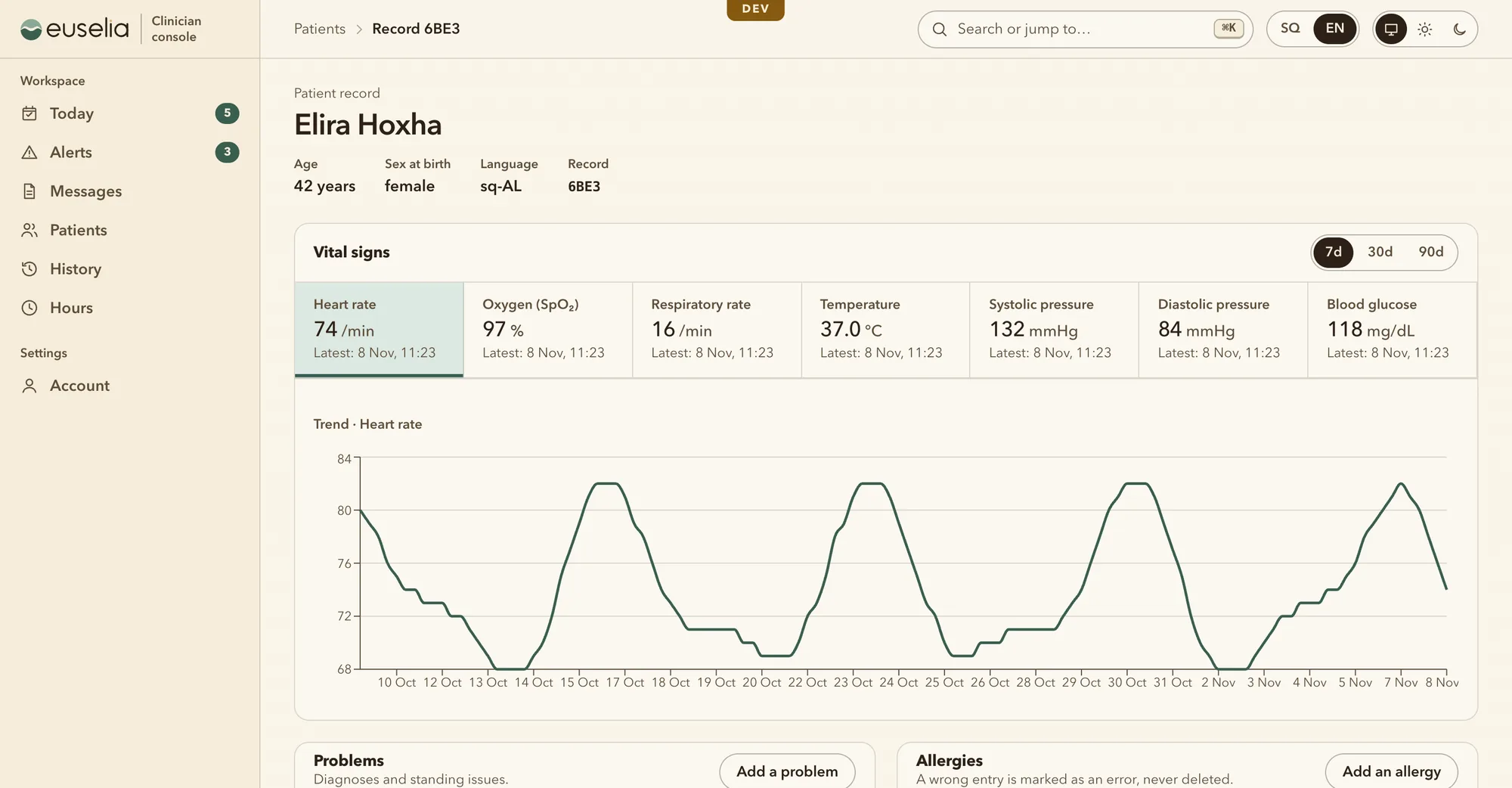
Each patient has a clinical record the treating doctor can read and write: problems, allergies shown wherever a prescription is written, visit notes that are signed and then amended instead of overwritten, and documents the patient can download. Doctors see only the patients they have treated; a record cannot be browsed.

The patient owns their data. They can export everything in one action, or ask to be erased, and the erasure carries on step by step even if it is interrupted.

Euselia patient record with vital signs trends, problems and allergies

AI in the line

Let intelligence prepare the work. Keep authority human.

Euselia does not put a chatbot next to a medical record. Models get narrow jobs, grounded inputs and written rules about what they may and may not do, and every output carries its provenance.

AI can sort and summarise

Order the day by urgency. Restate a patient's own words as a short summary, marked unverified. A low-confidence case goes to a human.

AI can notice in context

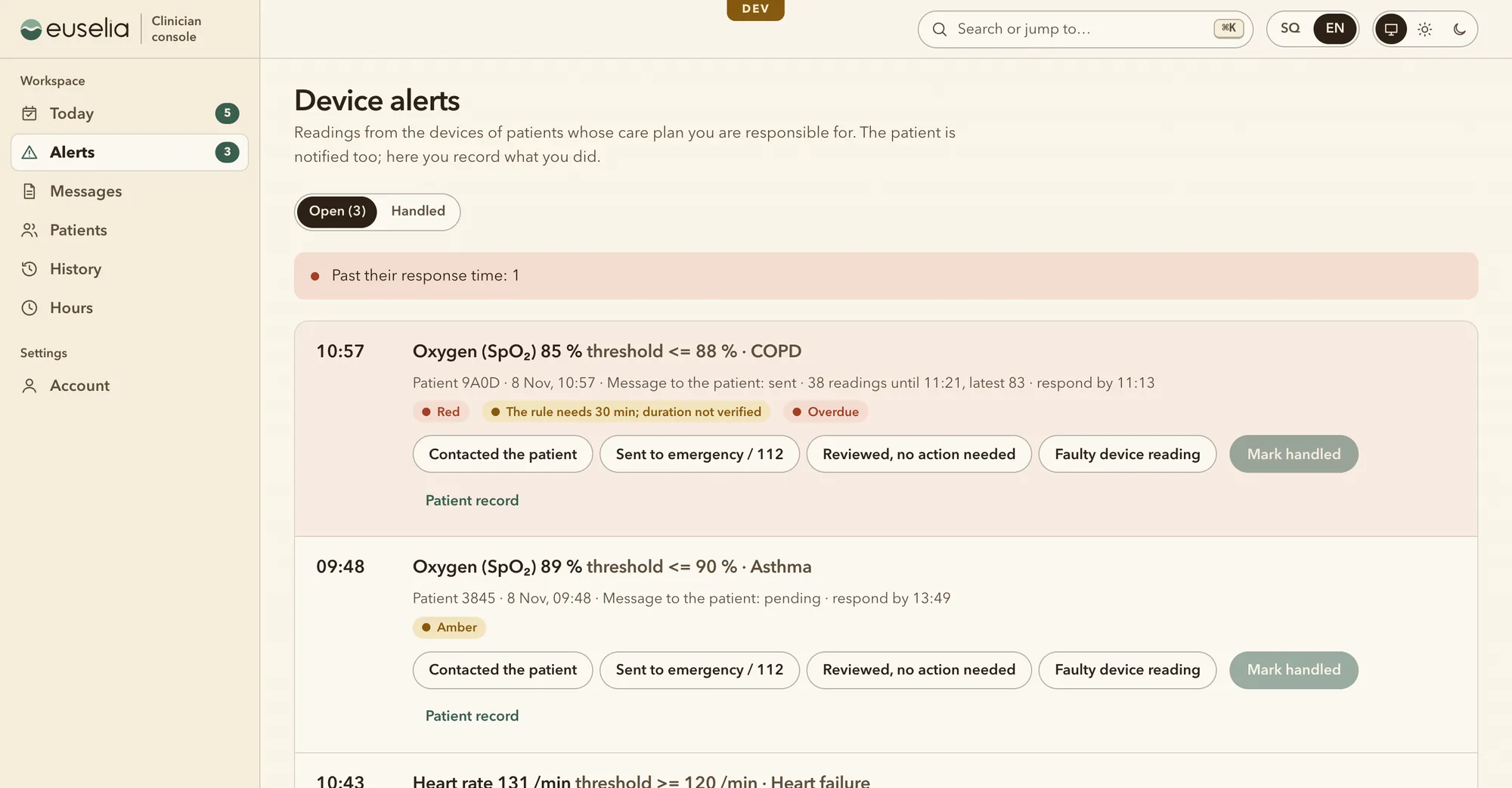
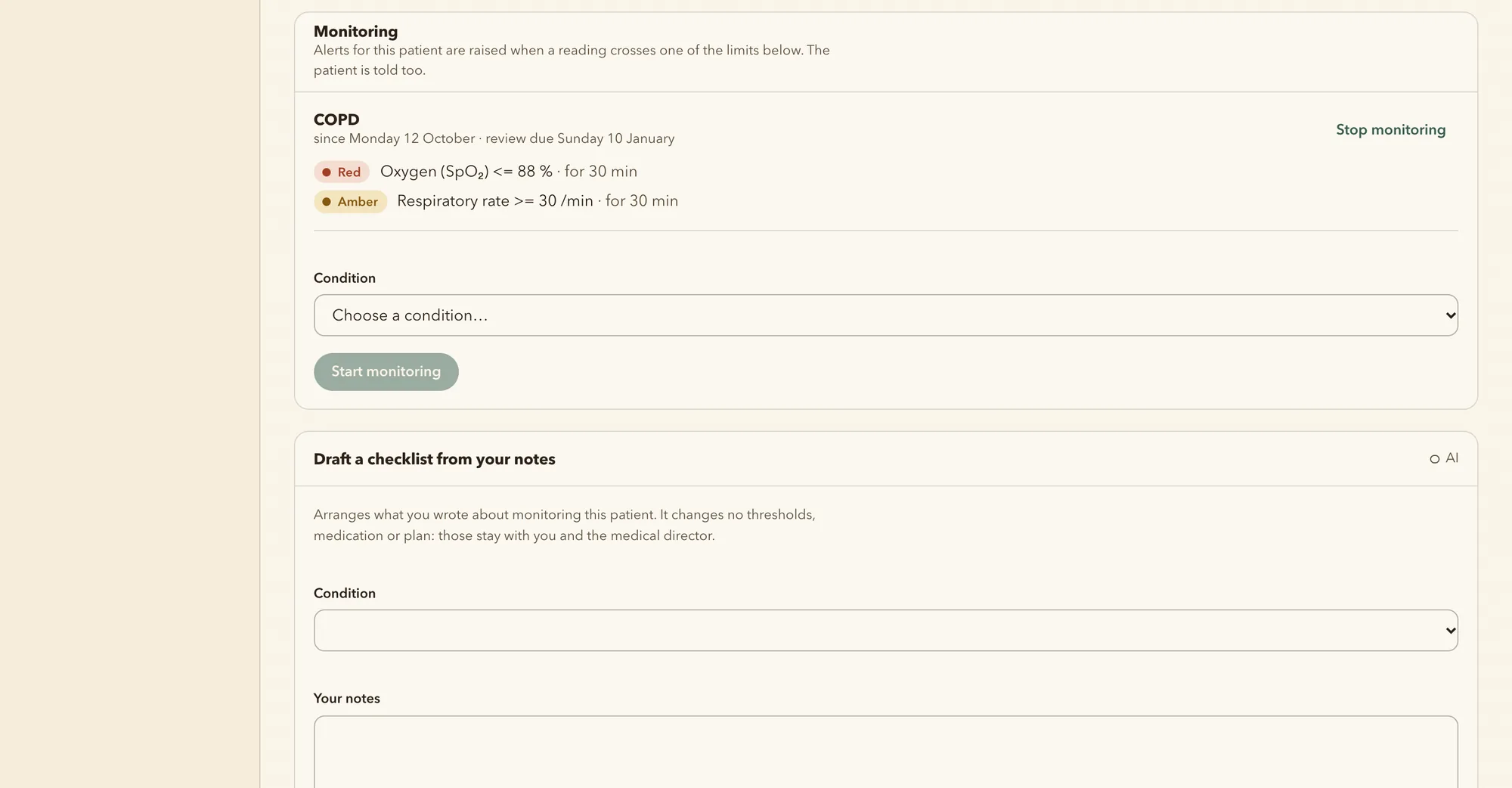
Compare a person's recent signals with their own history and raise a finding. Findings are informational: they page no one and message no one.

The doctor decides

Diagnosis, prescribing, signing and every message to a patient. A draft is the doctor's to edit, sign or discard.
Euselia care-plan monitoring with doctor-set oxygen and respiratory limits, and an AI checklist form that only arranges the doctor's own notes

A draft is arrangement, never new facts.

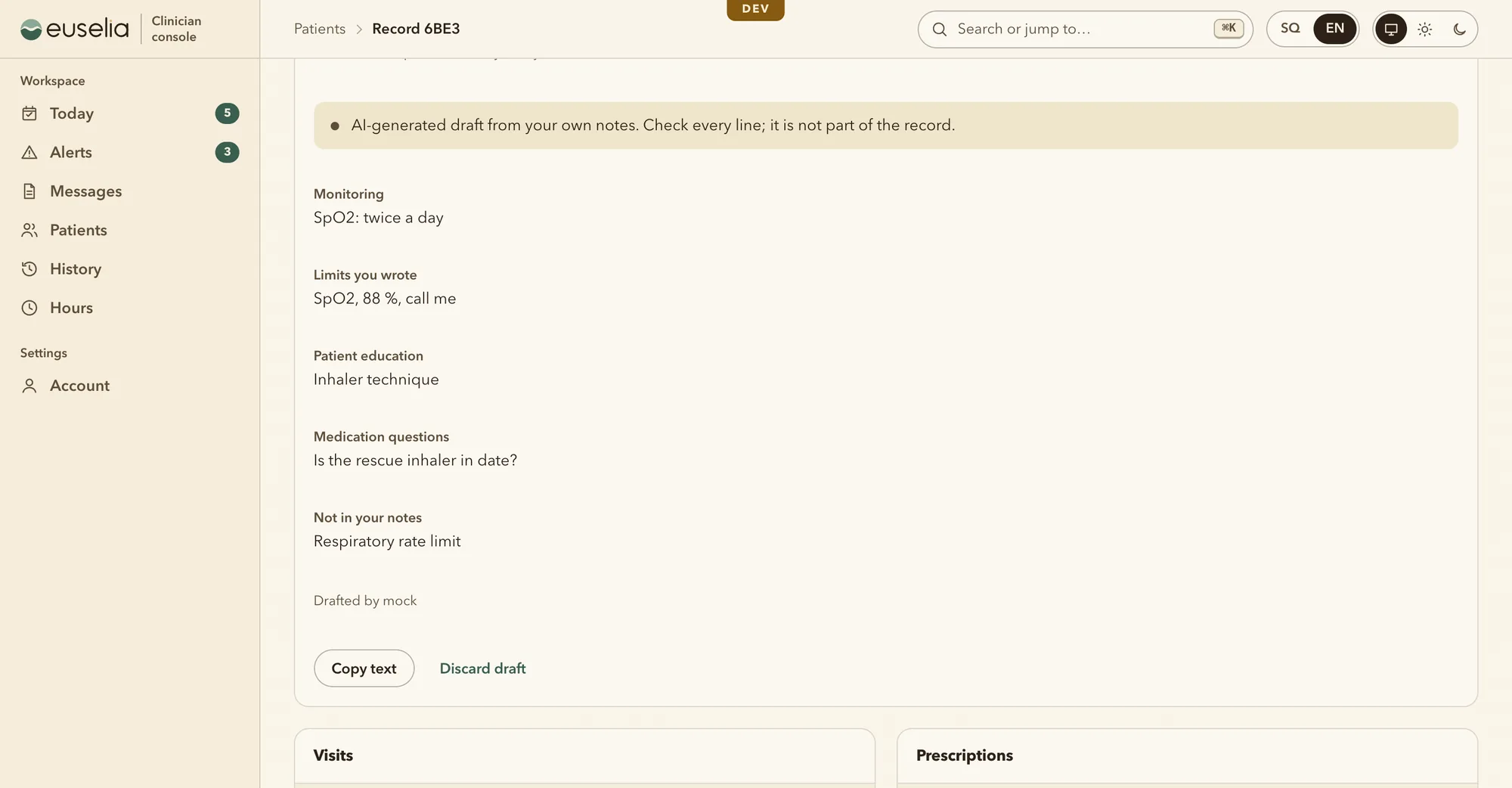
An optional assistant can turn a doctor's own rough notes into a structured visit note or a care-plan checklist. It adds no clinical content the doctor did not write, names no drug or dose, changes no threshold, and signs nothing. It is off by default, and the draft stays labelled until the doctor has checked every line.

Anything that comes from outside, such as a patient's message or an uploaded file, is wrapped and labelled as data, not as instructions.

Euselia care-plan checklist draft built from the doctor's notes and labelled as a draft

A model earns its voice.

A model that has not been validated on local clinical data does not speak to a clinician at all. It runs silently and is measured, until a person decides it has earned a place on the screen. A forecast model may annotate a finding with whether it agrees. It cannot create one.

Where Euselia shows something a machine produced, it says what it is, where it came from and what a person should do next.

Show what a machine made, and say so.

Three labels run through the product, and none of them depends on colour alone.

Unverified

Patient-written summaries and AI drafts say so wherever they appear.

Informational

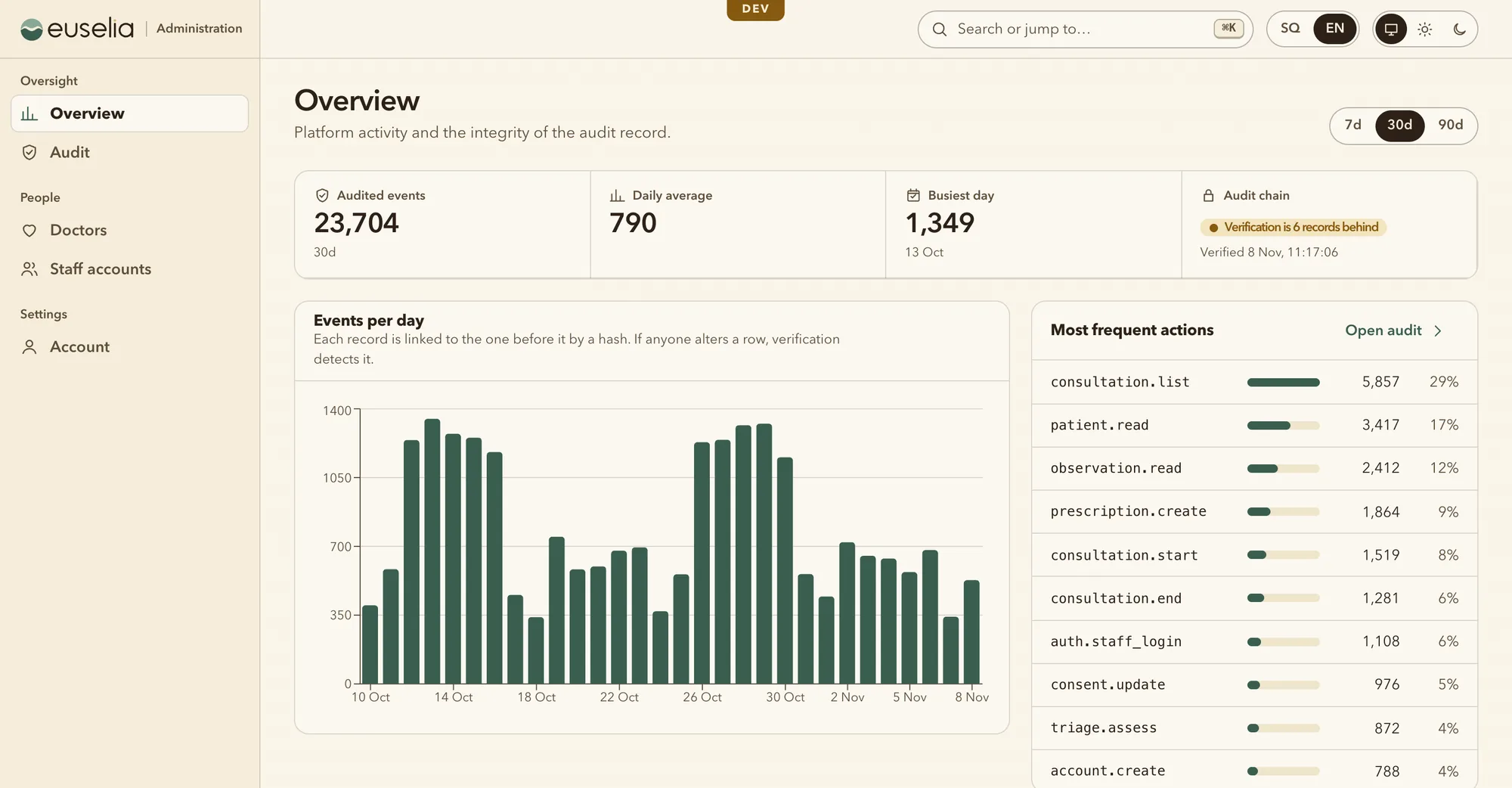
Findings from a person's own baseline never page or message anyone.

Silent

Models not yet validated on local data run in the background and show nothing.

Trust is made of small, checkable things.

Language is the interface. The product is written in Albanian first, with variants for Albania, Kosovo and North Macedonia, and English second, using the clinical vocabulary of the region rather than a translation of someone else's.

Consent has a scope. Triage, telemedicine and wearable sync are separate consents. Withdraw one and that data stops being used.

Encrypted at rest, audited in motion. Clinical content is encrypted field by field. The audit chain stores hashes, never the text of a record.

Built for a bad day. One-tap emergency call on the home and assessment screens, a console that signs itself out on a shared workstation, backups that are rehearsed rather than hoped for.

Accessible by default. WCAG 2.2 AA targets, light and dark, large type, status never carried by colour alone.

Euselia gives a doctor's attention more reach, and leaves the doctor in charge of what it finds.

Return to works